From Sin to Therapy: How the Church Lost the New Birth
I recently read Michael Madden’s book Heart, Mind and Conscience: The Preaching of the Free Church of Scotland 1843-1873. The book documents the preaching of a number of ministers that left the Church of Scotland to form the Free Church of Scotland in 1843.
Broadly speaking, the parties involved in the split were
categorised as the ‘Moderates,’ associated with the established Church of
Scotland, and the ‘Evangelicals,’ who left to form the Free Church of Scotland.
An emphasis in the preaching of the Free Church men was the need for the new
birth. Many ministers are named as not being born again until well into their ministries.
My interest in the book was primarily motivated by a desire to understand why preaching in the Presbyterian Church of Victoria is lifeless.
Sermon after sermon that I hear, whether in person or online focuses on reforming behaviour and exclude the need to be born again. This article proposes that the predominate view of sin in preaching is “brokenness”, not “rebellion”. And whilst this view of sin may seek to be seeker sensitive, “brokenness” redefines Christianity.
This is a subtle shift, but when sin is no longer described biblically as rebellion against a holy God, humanity is no longer presented as guilty rebels standing before divine justice. Rather, humanity is presented as in pain, damaged, dysfunctional, wounded, incomplete, more of as victims needing restoration and rather than needing mercy and forgiveness.
At this point, the matter becomes very serious. Brokenness can be alleviated with therapy and restoration. Sin can only be dealt with through the atonement of Jesus Christ and the new birth. When our ministers preach brokenness, there is very little reason to preach the necessity of the new birth. Even more seriously, the therapeutic preaching of sin so prevalent in the PCV is likely revealing that a vast number of the ministers have not been born again, much like those of the early 19th century Church of Scotland ministers. They cannot preach the necessity of the new birth because they seem to be getting along just fine without it.
As outrageous as the above paragraph may be to some people, the person who has been born again has been brought by the Holy Spirit under the conviction of his personal sin and the righteous judgement awaiting him. He becomes well aware that he is more than broken or needing help in a few areas. Even this psychological view of his condition forms part of his sin. He is aware of the sinfulness of sin, that no amount of therapy will remove sin’s corruption. Even his confidence that moral reformation or therapeutic improvement can repair him becomes part of his awareness of self-righteous blindness for which he stands condemned.
None of this denies that brokenness can describe real effects of the Fall. However, when sin is consistently presented as brokenness and as a controlling category for understanding sin, the necessity of regeneration begins to disappear. Yesterday I listened to two sermons online; one on the resurrection of Christ:
“Christians can be glad Jesus rose again”
and the other on the Lord’s Prayer.
“We are asking for more of heaven to invade earth. More justice where there is injustice. More healing where there is pain. More truth where there is confusion.”
Both sermons presented humanity as broken and requiring restoration. Yet the Scriptures always presents humanity as rebels who require a payment for their sin and the certain hope of resurrection based upon Christ’s resurrection. The two sermons just spoken of presented damaged selves that required instruction for rehabilitation. A dead sinner must be born again.
Madden’s book gave examples of sermons that retained traditional Scriptural language. The sermons used terms like grace, love, hope, and even the cross, but the gospel was absent. The centre had shifted. Those 19th century preachers did not use terms such as brokenness, but they did emphasise moral correction. This is a vastly different gospel than the news that condemned sinners must flee to Christ and be born again before the final display of the wrath of God is poured out.
If we examine the faith of ministers who preach sin as requiring moral correction, we are forced to ask what constitutes their faith? Biblical faith arises from a conviction of sin and flees to Christ as the only refuge from the wrath of a holy God. A faith based upon a therapeutic view of sin seeks the relief and restoration that will lead to personal acceptance before God. The sinner who believes he has become stabilised through their emotional healing no longer cries out “God be merciful to me, a sinner”, rather the predominate belief is they are now presented to God as satisfactorily repaired ready for eternal life.
Objectively, these are two rival religions that may use similar language but one has the self at its centre, and the other is the gospel with Christ at its centre.
If this analysis is correct it helps to explain why much contemporary preaching lacks spiritual authority. Men who have never themselves been slain by the law of God cannot preach with urgency to dying sinners. Men who have only discovered brokenness cannot proclaim reconciliation with God because they have never trembled beneath His judgement. Sure, through some spiritual experience many may have discovered they fall short in some areas of their lives and can now speak fluently about vulnerability, authenticity, shame, trauma, and emotional wounds. I am not denying that. What is missing in their sermons though is mention of wrath, enmity with God, condemnation, repentance, mortification of sin. Even the fear of the Lord is now presented as the Christian holding God in awe.
The result is dead sermons. Sermons that sound more like second tier counselling sessions, rather than prophetic proclamations from another world.
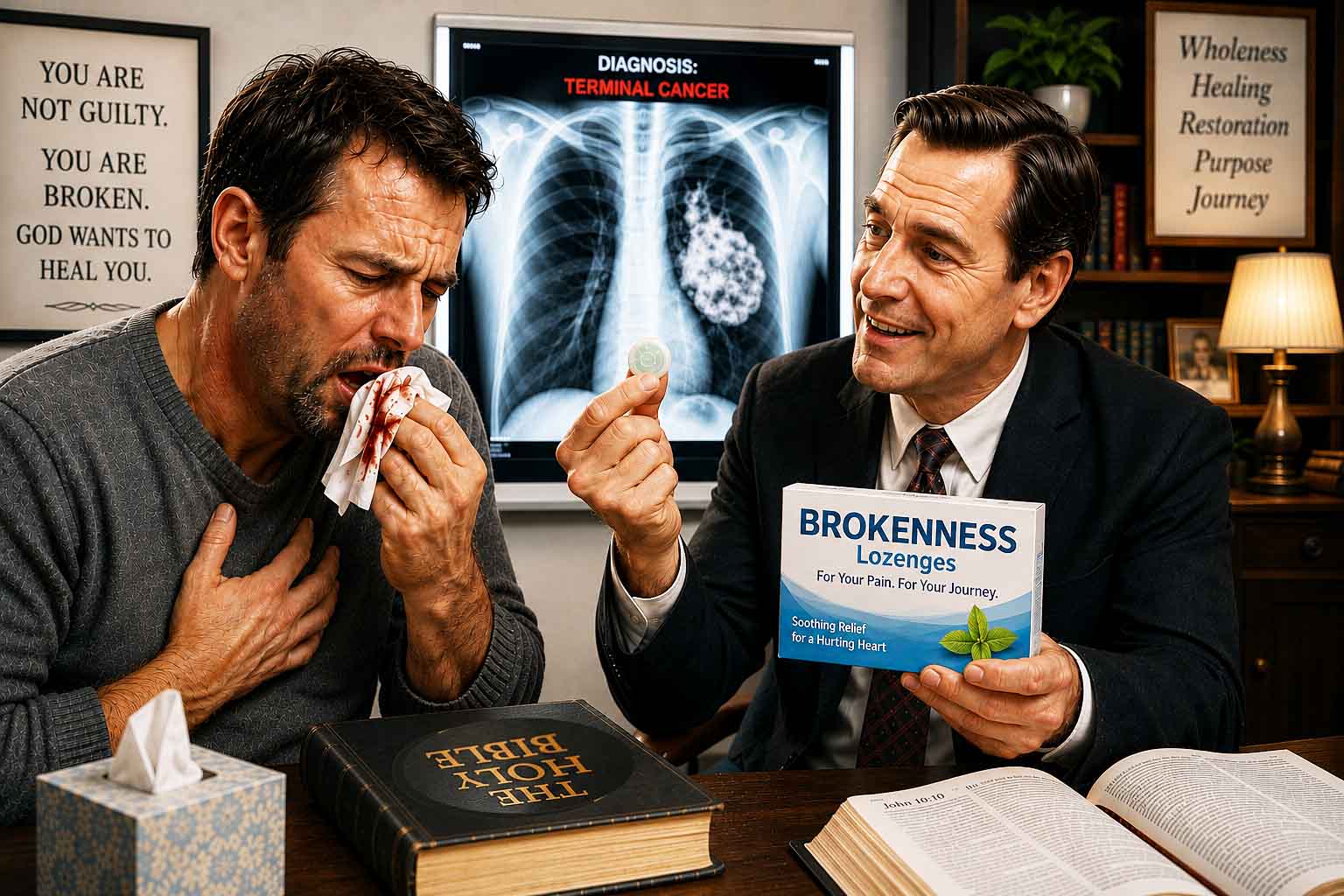
The tragedy is that brokenness preaching often appears compassionate. The preacher may gladly accept the label of being pastoral in his sermons. The reality is that such preaching is cruel and of the devil. Preaching that tells condemned sinners they are merely wounded is like comforting a man coughing blood with a lozenge, whilst refusing to tell him he has cancer that is killing him. The momentary relief deepens the self-deception and ensures their ultimate damnation.
Like the Church of Scotland in the early 19th century, the Presbyterian Church of Victoria desperately needs ministers who believe that humanity is not merely bruised by sin, but enslaved to it. Their congregations contain people who are not merely damaged but dead, not merely hurting but already stand in the dock as condemned criminals. Until such conviction returns, ministers will continue producing sermons full of empathy yet empty of resurrection power.
We are not talking about defective theology here. That exists. It must exist when sin is recast in terms of brokenness. We are talking about unregenerated hearts and the offense of the cross. And I want to emphasise here that unregenerate hearts are on display whenever sin is portrayed as brokenness. For the man who has truly been brought from death to life never speaks lightly about the condition from which he himself has been rescued from.
The truth is, there are no grounds for thinking that the situation of the 19th century Presbyterian church cannot repeat itself. Madden’s Heart, Mind and Conscience true value may be to alert us to history repeating itself. His book is available at Amazon.
Michael J. Madden, Heart, Mind and Conscience: The Preaching of the Free Church of Scotland 1843-1873.