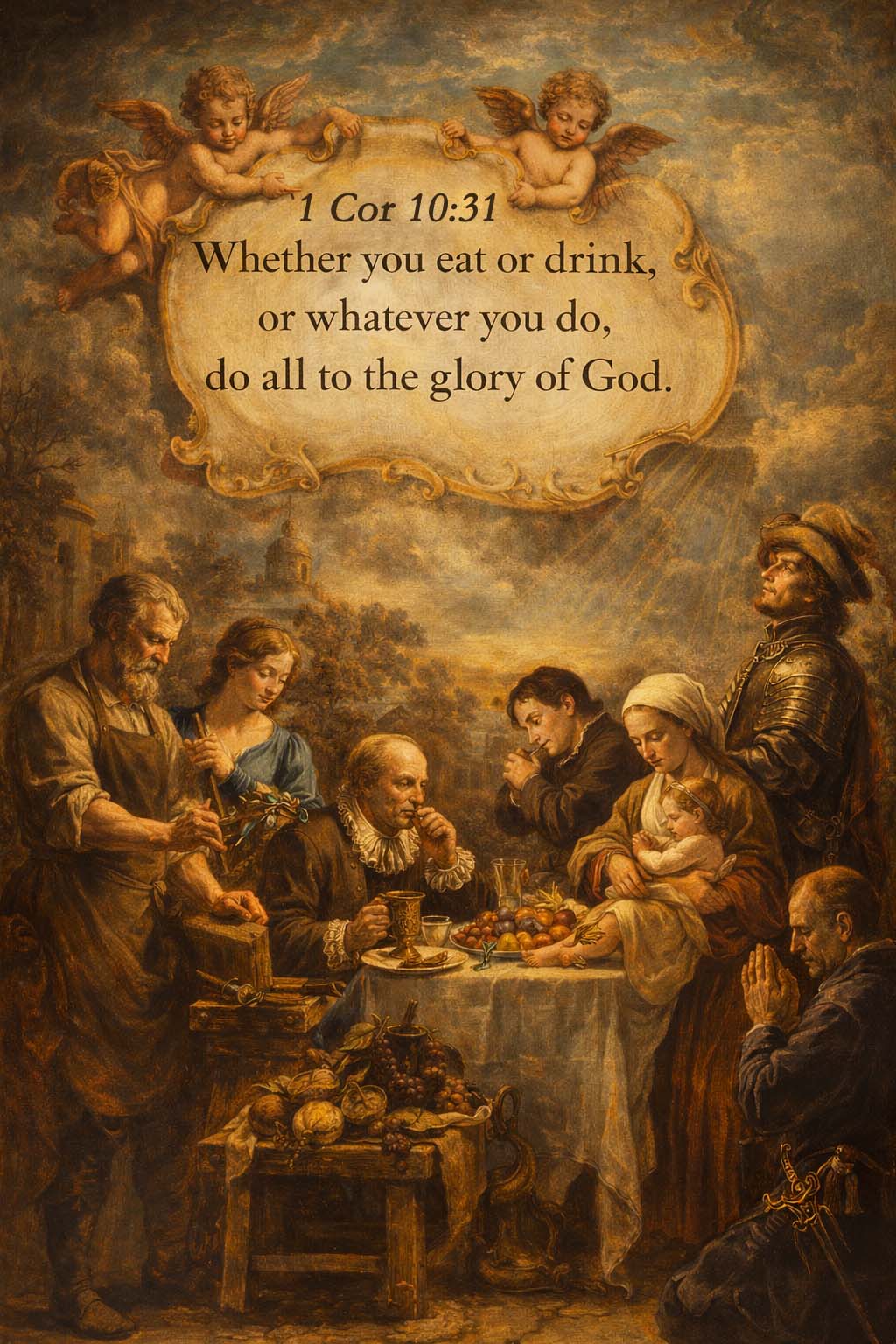
All to God's Glory: 1 Cor 10:31
Whether therefore ye eat, or drink, or whatsoever ye do, do all to the glory of God.
I take this word in hand
knowing how easily it slips from memory once the page is turned. The command is
simple enough to read, yet hard to keep company with for long. It follows us
into kitchens, workshops, conversations, and choices we would rather leave
unexamined. The apostle does not raise his voice, but he does narrow the path,
and before we know it, there is no corner of life left untouched.
The command is plain and
searching: “Whether you eat or drink, or whatever you do, do all to the glory
of God.” There is nothing lofty here at first glance. No temple courts. No
martyr’s fire. No heroic acts that make biographies swell. Eating. Drinking.
Doing. The apostle places the weight of God’s glory upon the most ordinary
movements of life, and by doing so he quietly removes every excuse we make for
a divided obedience.
Paul is addressing a
church troubled by questions of liberty, conscience, and conduct. Some were
eager to press their freedom to its limits. Others were easily wounded. Into
this tangle he does not first introduce a rulebook, but an end. He does not
ask, “What am I allowed to do?” but, “What is this for?” The glory of God is
not an ornament added to Christian life; it is the reason for it. When the end
is lost, even lawful things begin to rot in the hand.
The trouble is not that
we eat and drink, but that we eat and drink forgetfully. We rise, work, speak,
choose, rest, and sleep as though life were a corridor with no destination. God
becomes a visitor to our days rather than their owner. I once reorganised my
shed with great seriousness and still could not find the screwdriver the next
day, which is a small picture of a much larger disorder. When the great end is
misplaced, nothing stays where it belongs.
This text gently but
firmly restores proportion. My meals are not interruptions to devotion; they
are places where devotion must learn to walk. My work is not neutral ground; it
is a field in which God’s honour is either sought or ignored. Even our liberties,
so dear to us, are not self-authenticating. They must answer the question: does
this magnify God, or merely indulge me?
Here the gospel steadies us. The glory of God is not a burden laid upon forgiven sinners to prove their worth. It is the glad alignment of a redeemed life with its true centre. We do not glorify God in order to be accepted; we glorify Him because, in Christ, we already are. The Son has lived a fully Godward life in our place, and the Spirit now bends our crooked desires back toward that same end, patiently, often slowly, but truly.
So we learn to ask new questions of old habits. Why do I speak this way? Why do I choose that path? Why do I insist on this right? The aim is not to become anxious accountants of holiness, but joyful servants who know whom they serve. The smallest act, done with a Godward heart, is caught up into something eternal.
Let us not despise the smallness of obedience. Heaven measures differently than we do. To eat, to drink, to work, to rest, and to do so with God consciously honoured, is no small thing. It is a life gathered back to its proper end.
Let us pray.
Gracious Father, we confess how easily we live for lesser ends. Gather our scattered hearts. Teach us to honour You in the ordinary paths of our days. Through Jesus Christ our Lord, who lived wholly for Your glory, and by Your Spirit who trains us to do the same. Amen.