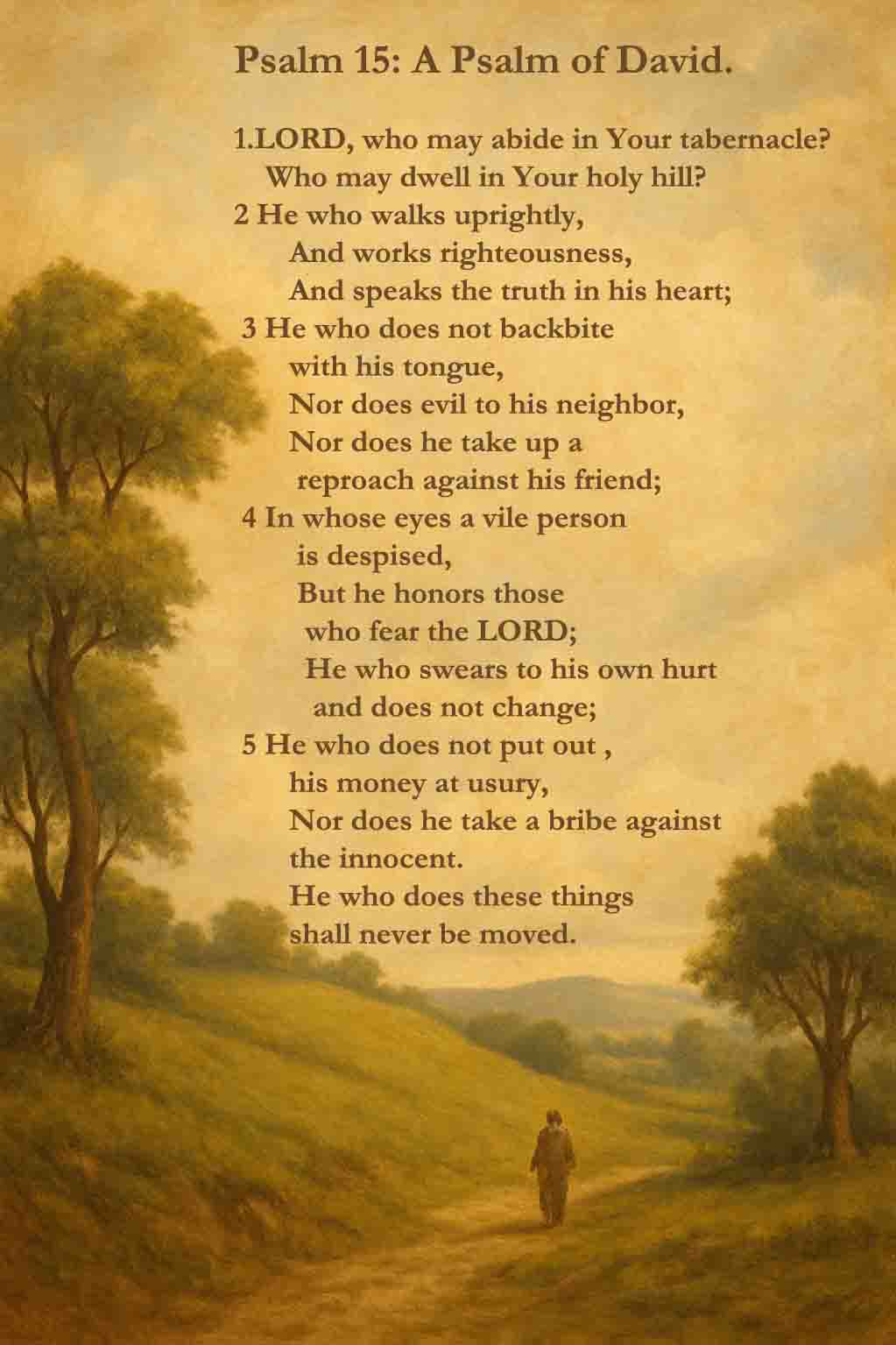
Rev Josiah Cartwright Devotion: Psalm 15:1–5
“Lord, who shall abide
in thy tabernacle? who shall dwell in thy holy hill?” (Psalm 15:1).
Beloved, our psalm
begins with a question fit to sober every heart. David stands before the
dwelling place of the Most High and asks who may remain where God makes His
presence known. The tabernacle was that tent where the Lord spoke from above
the mercy seat (Ex 25:21–22), where fire descended (Lev 9:23–24), and where the
people trembled because the Holy One had drawn near (Ex 40:34–35). To abide
there was no small privilege. It was the life of communion, the nearness that
Moses longed for when he said, “If thy presence go not with me, carry us not up
hence” (Ex 33:15).
David does not ask who
may glance at the holy place but who may dwell there. The word carries a sense
of continuance, the settled life of one accepted. The holy hill, later Zion,
was chosen by God for His habitation, as He said, “This is my rest for ever;
here will I dwell” (Ps 132:14). The question therefore touches the very height
of blessedness, for “Blessed is the man whom thou choosest and causest to
approach unto thee” (Ps 65:4).
David then describes
the character of the one who may come near. He must walk uprightly, as Noah
walked with God (Gen 6:9). He must work righteousness, reflecting the Lord who
“loveth righteousness and judgment” (Ps 33:5). His speech must be true, for the
God of Israel is a God who “cannot lie” (Num 23:19). He must refrain from
harming his neighbour, for the Lord commanded, “Thou shalt not go up and down
as a talebearer among thy people” (Lev 19:16). He must despise what God
despises (Ps 101:3–4) and honour what God honours (1 Sam 2:30). He must keep
his word even at cost, for the Lord Himself is faithful in all His promises
(Josh 23:14). He must refuse unjust gain and protect the innocent, for the Lord
“regardeth not persons, nor taketh reward” (Deut 10:17).
Thus the psalm sets
before us not the righteousness of men but the righteousness that reflects the
God who calls His people to holiness (Lev 11:44). It is the character suited to
His dwelling. It shows that communion with God is no light matter. To draw near
to Him is to draw near to burning purity. And yet David closes with hope, for
the one who lives this life “shall never be moved” (Ps 15:5). He stands firm
because the God who receives him is firm. He is held by the Lord who is “the
strength of my heart and my portion for ever” (Ps 73:26).
But beloved, as we hear these words, we sense our own frailty. We know how far our speech falls short of truth, our affections of purity, our dealings of justice. The psalm does not flatter us. It reveals the height of God’s holiness and the poverty of our own estate. It sends us searching for mercy beyond ourselves, for the Lord who “forgiveth all thine iniquities” (Ps 103:3) and who covers the sin of the contrite (Ps 32:1–2). David knew that no man stands before God by native worth, and he cast himself upon the steadfast love of the Lord, saying, “Enter not into judgment with thy servant” (Ps 143:2).
And here, at the edge of David’s own light, another dawn breaks for us who read the psalms in the fullness of time. The righteousness described is not found in us, yet God has revealed One in whom it dwells perfectly. The path into the holy place has been opened by Him who fulfilled all righteousness and brings many sons to glory. In Him alone do we dwell securely and abide with the Lord forever.
Let us pray.
Most high God, thou art holy and thy dwelling is holy. We confess our unworthiness and praise thee for thy mercy. Teach us thy ways. Form in us the righteousness that reflects thy character. Lead us to the One who opens the way into thy presence and keep us steadfast by thy Spirit, until we dwell with thee in everlasting joy. Amen.