𝐓𝐡𝐞 𝐒𝐩𝐨𝐧𝐬𝐨𝐫𝐞𝐝 𝐒𝐚𝐯𝐢𝐨𝐮𝐫: 𝐖𝐡𝐞𝐧 𝐂𝐨𝐦𝐦𝐞𝐫𝐜𝐞 𝐈𝐧𝐭𝐫𝐮𝐝𝐞𝐬 𝐮𝐩𝐨𝐧 𝐭𝐡𝐞 𝐈𝐧𝐜𝐚𝐫𝐧𝐚𝐭𝐢𝐨𝐧
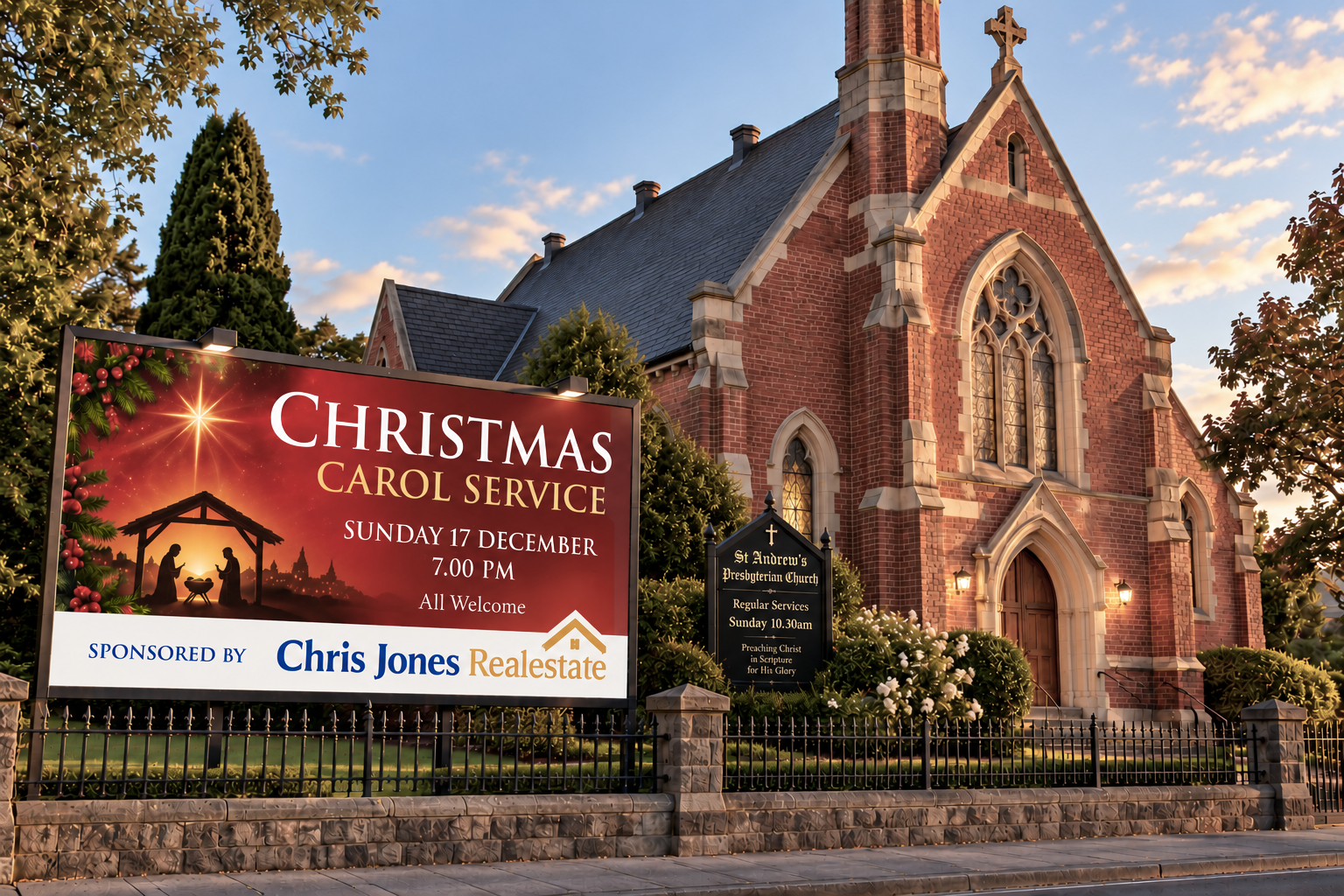
It is that time of the year again when too many Presbyterian congregations are willing to accept commercial sponsorship for Christmas carol events, particularly from local real estate agencies. The arrangement is frequently advertised through a conspicuous band across the top or bottom of a promotional billboard, prominently displaying the sponsoring agency's name and corporate logo.
What ought to direct public attention towards the incarnation of the eternal Son of God becomes, at least in part, an advertising opportunity for a commercial enterprise. The practice is abhorrent, not because the provision of financial assistance is inherently objectionable, but because the Church has permitted commercial promotion to occupy a prominent place in its public proclamation of Christ.
There is a deeper cultural contradiction here. Real estate is not concerned merely with providing shelter, a legitimate human necessity. Its contemporary commercial presentation frequently appeals to property investment, capital appreciation, financial security, prestige, and the pursuit of a desirable lifestyle. None of these associations necessarily characterises every agency or transaction. Nevertheless, they reflect aspirations that must be examined critically in the light of the Christian's identity as a pilgrim and stranger in this world. The believer's inheritance is not ultimately an earthly estate, nor is his security found in accumulating property.
The Church therefore ought to consider carefully the incongruity of prominently advertising an enterprise associated with earthly acquisition while proclaiming the coming of Him who had nowhere to lay His head.
I must acknowledge that the Presbyterian Church of Victoria is by no means alone in adopting this practice. Although I have not undertaken a comprehensive survey of churches accepting commercial sponsorship for Christmas carol events, I have observed similar arrangements among Uniting Church congregations and even at the local Wesleyan Methodist Church in Silvan. Each year, as I travel towards Melbourne through the established and relatively affluent eastern suburbs of Surrey Hills, Canterbury, and Camberwell, I encounter Presbyterian churches advertising Christmas celebrations with the names and logos of local real estate agencies prominently displayed.
These are suburbs characterised by substantial residential property values and, in some congregations, considerable material resources. That makes the apparent dependence upon commercial sponsorship all the more difficult to understand. I do not suggest that every congregation in these suburbs is wealthy, nor that the presence of affluent members removes every financial difficulty. Nevertheless, the spectacle of churches in prosperous communities promoting commercial property interests in conjunction with the commemoration of Christ's incarnation raises a troubling question.
Has the Church become so accustomed to the commercial practices of the surrounding culture that it no longer recognizes the incongruity of allowing the proclamation of the Saviour's birth to serve simultaneously as an advertisement for the acquisition and sale of earthly property?
The arrangement becomes still more questionable when alternative sources of financial assistance are available. Congregations of the Presbyterian Church of Victoria may apply for denominational grants towards Christmas evangelism and outreach, with grants reportedly averaging between $1,000 and $2,000. If such provision is available, why should congregations consider it necessary to exchange prominent advertising space for commercial sponsorship? Even where grants are insufficient to meet every expense, financial convenience cannot determine the propriety of the Church's public witness.
There is, however, a further danger that may be less visible but more consequential. Commercial sponsorship can create an unspoken expectation that the event remain agreeable, welcoming, and free from anything likely to offend the wider community. No sponsor need expressly demand such accommodation. The mere desire to preserve goodwill, maintain future support, and ensure the event's continued popularity may exert a subtle influence upon the minister's proclamation. The temptation is to speak warmly of the manger while avoiding the reason for the incarnation: man's guilt before a holy God, the necessity of repentance and regeneration, and the redeeming work of Christ through His obedience, blood, and death. Evangelically warm, Christ-centred, and broadly orthodox messages aimed to be seeker sensitive is usually the order of the day.
I do not suggest that every minister whose congregation accepts sponsorship has yielded to this temptation. Such a charge would require examination of the preaching itself. Nevertheless, the danger is real, and the Church ought not willingly create circumstances in which the uncompromised proclamation of the gospel may appear to compete with the expectations of commercial benefactors.
The question is ultimately one of spiritual independence. The Church has been entrusted with a message that necessarily confronts the sinner with his guilt and directs him to the crucified and risen Redeemer. It must therefore remain free to proclaim that message without consideration of whether its commercial supporters, invited guests, or surrounding community find it agreeable.