Hesed in Hosea 12:6
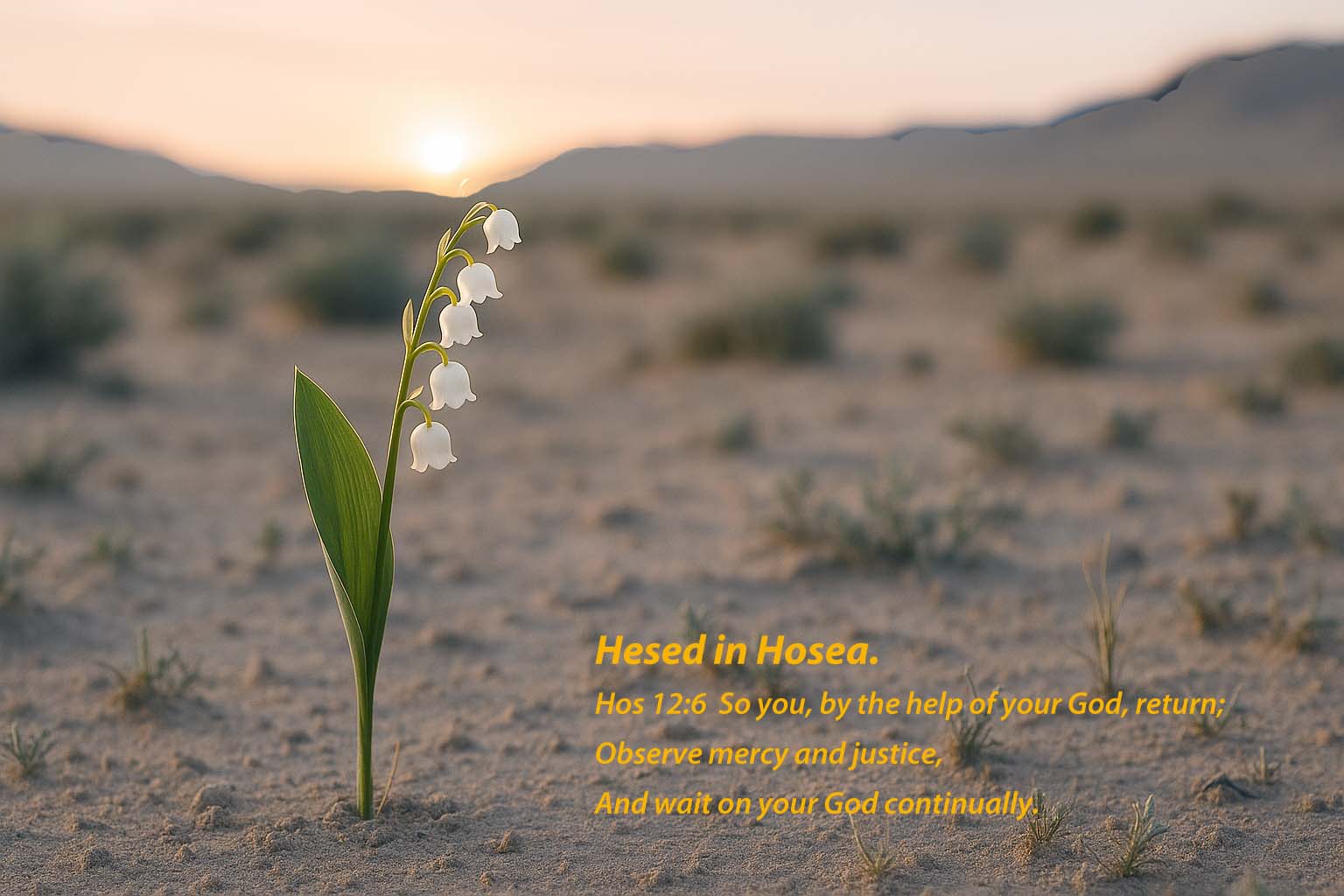
Study 5: Waiting for Our hesed God
This is our final study on the word “hesed” in Hosea. Each of the five occurrences of ḥesed in Hosea are not scattered about as ornaments; rather they are like carefully placed load-bearing beams.
Each use advances the book’s argument about covenant
rupture and covenant restoration, and together they press inexorably toward the
exhortation of Hosea 12:6. To understand the “therefore” of that verse, we must
first trace how ḥesed has already done its work from our previous studies.
This final study will also be slightly longer than the previous four studies as
we look to Calvin, but also as we relate the covenant life of hesed to
the 10 Commandments.
The first use appears in Hosea 2:19, at the great turning point of judgment into promise. Here ḥesed belongs wholly to God: “I will betroth you to Me forever… in righteousness and in justice, in ḥesed and in compassion.” The covenant is not repaired by Israel’s repentance but re-founded in God’s own character. As Calvin observes, God “binds Himself by His own faithfulness,” so that the stability of the covenant rests not on Israel’s constancy but on God’s gracious resolve. Ḥesed here is unilateral, creative, and promissory. It establishes the moral horizon of the book: whatever obedience God later demands will be the fruit, not the root, of His love.
The second use of hesed, in Hosea 4:1, turns sharply from divine promise to human failure: “There is no faithfulness or ḥesed or knowledge of God in the land.” What God pledged in chapter 2 is precisely what Israel lacks in chapter 4. Calvin insists that this absence is not mere moral deficiency but covenantal collapse. Religion continues, but relational fidelity has vanished. The lawsuit motif exposes Israel as a wife who still inhabits the house yet no longer loves the husband. Ḥesed is absent because the knowledge of God has been rejected.
The third use, Hosea 6:4, deepens the diagnosis: “Your ḥesed is like a morning cloud.” Israel’s love exists, but it is weightless and transient. Calvin is unsparing here. He argues that Israel’s repentance is theatrical rather than truthful, driven by fear of punishment rather than reverence for God. This “ḥesed” evaporates as soon as pressure lifts. Hosea thus exposes the inadequacy of emotional religion. Covenant love cannot be momentary if it is to mirror the God who is “from everlasting.”
The fourth use, Hosea 6:6, states the theological core with brutal clarity: “I desire ḥesed and not sacrifice.” God rejects cultus severed from loyalty. Calvin notes that God is not abolishing sacrifices per se but condemning their use as substitutes for obedience. Ḥesed here is the ethical shape of covenant faithfulness. It names a life ordered by loyal love toward God and neighbour, flowing from true knowledge of God. This verse marks the transition from diagnosis to demand, but the demand remains grounded in who God is, not in what Israel can achieve unaided.
By the time we reach chapter 11, the tension is almost unbearable. God recounts His fatherly love, His tender care, His grief over Israel’s stubbornness. “My heart recoils within me; my compassion grows warm and tender.” Calvin reads this not as divine instability but as accommodated speech revealing the depth of God’s covenantal affection. Justice that demands judgment is in tension with ḥesed that resists abandonment. Chapter 11 explains why judgment in Hosea is never the last word. The ache of God’s heart makes total destruction impossible. Love restrains wrath.
As an aside, this covenant theology also points to God continuing to have plans for Israel today. The church has not replaced Israel, rather one bride for Christ is being prepared consisting of Jews and Gentiles.
Chapter 12 then gathers the threads. Israel is again behaving like Jacob: grasping, deceitful, self-reliant. History is recalled to show continuity of sin. Yet the same God who met Jacob at Bethel still speaks. The covenant Lord has not changed. Against this backdrop comes Hosea 12:6: “Therefore, by the help of your God, return; hold fast to ḥesed and justice, and wait continually for your God.”
The “therefore” gathers everything. Because God pledged ḥesed (2:19), because Israel lacked it (4:1), falsified it (6:4), and was commanded to embody it (6:6), and because God’s heart has not let Israel go (11:8–9), Israel is now summoned to live by what God has given. Calvin is explicit: the exhortation rests on grace. “By the help of your God” excludes all Pelagian readings. God does not demand what He does not supply.
Thus, the final use of ḥesed is neither sentiment nor abstraction. It is covenant life restored. Divine love, once promised, now becomes human obedience sustained by grace. The book ends not with ritual, not with despair, but with a call to persevering loyalty grounded in the unchanging ḥesed of God Himself.
Now we must slow down over the text itself. Hosea 12:6 is not a general summons to “do better.” Each of the three clauses presses Israel back into the moral shape of the covenant. If the “therefore” gathers the whole book, these three clauses specify what covenant return actually looks like.
“Return to your God.” The first clause is directional and relational. Hosea does not say merely, “Repent from your sins,” but “Return to your God.” The Law begins here. The first commandment demands exclusive allegiance: no other gods. The second regulates worship: no images, no manipulative inventions. The third governs the Name: not carried in vain. The fourth sanctifies time as belonging to Him. To “return” is therefore to come back under the Lord’s rightful claim, to renounce rival loves, and to take again the posture of a worshipper rather than a bargainer.
And Israel’s history in Hosea is precisely the opposite. She has returned to Baal again and again. She has blended Yahweh with idols until she no longer knows the difference. She has spoken the covenant Name while living as though the covenant Lord were a tool for success. She has treated worship as technique for prosperity. Hosea has already told us that the deepest problem is not ignorance of vocabulary but apostasy of heart: “There is no knowledge of God in the land.” When the first table of the Law collapses, the second follows. Return is therefore the necessary first word, because nothing else can stand until God is God again to His people.
“Hold fast to ḥesed and justice.” This is the ethical centre of the verse: covenant love and covenant order. Taken together, they are the Law translated into life. “Justice” names the righteous ordering of our dealings with others. It corresponds naturally to the second table of the commandments: honouring authority rather than despising it, preserving life rather than shedding blood, guarding purity rather than exploiting bodies, respecting property rather than stealing, protecting truth rather than lying, and refusing covetous desire rather than nursing it. Yet Hosea refuses to let “justice” become cold legality, so he binds it to ḥesed. That word insists that obedience must be loyal, relational, durable. It is the opposite of the morning-cloud religion of Hosea 6:4. It is not a moment of moral enthusiasm; it is steady love that keeps covenant when it is costly.
Israel has failed here at every point. Hosea 4 is practically a commentary on commandments broken: swearing and lying, murder and stealing, adultery, bloodshed piled upon bloodshed. The land groans because covenant ethics have been abandoned. Even when Israel performs religious acts, God says He does not recognise them as obedience, because “I desire ḥesed and not sacrifice.” They offer what is easier to give. They avoid the costly work of neighbour-love and God-fear. They prefer altar-smoke to righteous dealing, festival days to faithful speech, public piety to private integrity. The clause therefore exposes Israel’s false refuge: ritual without righteousness.
But Hosea 12:6 does something more searching. It binds ḥesed to justice so that no man can claim love while practising oppression, and no man can claim law while refusing mercy. Justice without ḥesed becomes tyranny. Ḥesed without justice becomes indulgence. God requires both because He Himself is both. This is precisely why Hosea earlier joined righteousness and justice to ḥesed and compassion in the betrothal promise. The life of the covenant people must resemble the covenant Lord himself.
The third clause now lands with weight: “Wait continually for your God.” This is where Hosea becomes most spiritually exacting, because he moves from outward conduct to the posture of the soul. Waiting is not passivity, or is it stoicism. It is faith’s persistence, hope’s endurance, and prayer’s refusal to quit trusting in the Word of God. Here the Law presses in again, because waiting is the internal obedience that the commandments assume. The first commandment demands not merely that we do not bow to idols, but that we trust, fear, and love God above all. The tenth commandment, in particular, reaches into desire itself, forbidding the restless cravings that drive us to take life by force. Waiting is the opposite of coveting. It is the soul saying, “God is enough, and God is faithful, and I will not seize what He has not given.”
Israel’s history is a history of refusing to wait. Hosea 12 itself describes her as trading, bargaining, and grasping. Instead of trusting the Lord, Israel trusts alliances and economies, Egypt and Assyria, cleverness and leverage. She has lived like Jacob before he was broken, not like Jacob after he clung to God. The entire book has portrayed Israel as impatient for security, impatient for prosperity, impatient for visible guarantees. That impatience is why Baal worship was attractive: it promised controllable outcomes. It turned the uncertainty of faith into the certainty of technique. To “wait continually” therefore strikes at the root of Israel’s desire to manage God.
This is where Calvin’s pastoral realism helps. He treats waiting as the necessary discipline of true religion, because our hearts are “always boiling with inordinate desires,” and therefore we are prone to run ahead of God. Waiting is the restraint of self-will. It is the confession that God’s timing is wiser than ours, and God’s providence better than our schemes. In Hosea’s context, it means refusing political idolatries, refusing religious manipulations, refusing the false urgency that says we must secure ourselves now.
And this is why the clause is so extensive. Waiting continually requires a whole re-formation of Israel’s instincts. It demands that Israel stop interpreting life by immediate circumstances and start interpreting life by the covenant character of God. It requires Israel to believe chapter 11: that God’s compassion restrains His wrath, that His heart is not fickle, that His holiness does not cancel His mercy, and that His mercy does not deny His holiness. Only a people who believe that can wait. If God is capricious, waiting is foolish. If God is merely sentimental, waiting is unnecessary. But if God is holy and faithful, then waiting becomes the truest expression of faith.
Notice, too, how Hosea guards the command with a word of grace: “by the help of your God.” Most English translations miss this point, but it is apparent in the Hebrew and the NKJV has preserved it. But it is also hinted at in v5 with the use of “LORD God Almighty”, that is, the sovereign Lord God of who rules over everything. Waiting is not natural to fallen man. It is learned through discipline and sustained by God’s active help. The same God who commands the stars supplies the strength to wait for Him. That phrase shuts the door to boasting and opens the door to repentance. Israel is not told to generate covenant life from within her own deadness, but to lean upon the God whose ḥesed has already pursued her.
So, Hosea 12:6 is not an isolated moralism. It is covenant renewal in miniature. The first clause calls Israel back to the Lord of the first table. The second clause orders Israel’s life under the second table, with ḥesed as the animating principle. The third clause reaches beneath both tables into the heart, commanding trustful perseverance over against the impatient idolatry that has marked Israel from Jacob onward. And the “therefore” means that none of this is abstract. It is the necessary response to a God who has pledged Himself, and His people are to walk by trusting in His promises (faith), and not to live by what they see around them.
This last use of ḥesed in Hosea is therefore the most searching. It is ḥesed no longer merely promised, or lamented, or desired, but demanded as the lived shape of a people brought home by grace. The God who says, “I will betroth you to Me in ḥesed,” also says, “Now, hold fast to ḥesed.” And the only way a Gomer-like people can do that is if they finally learn to wait for their God, continually, patiently, obediently, until His covenant love has done in them what His covenant love has promised.
For us, as we worship God as Christians in the 21st century, the call is exactly the same since we worship the same God as Hosea who never changes.