Hesed in Hosea 4:1
Study 2: A People Without Hesed
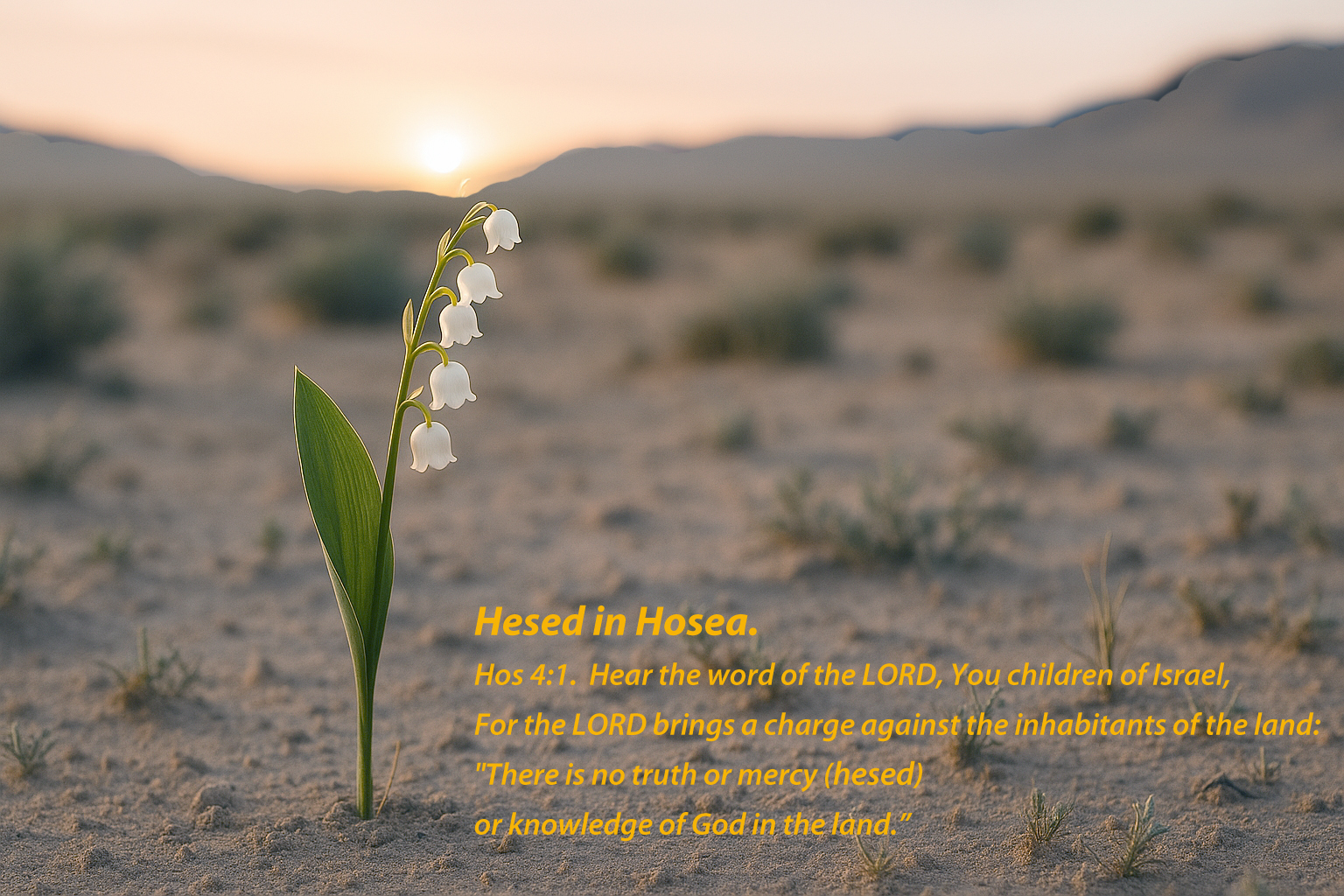
Hosea 4:1 – “Hear the word of the LORD, O children of Israel, for the LORD has a controversy with the inhabitants of the land: There is no faithfulness or steadfast love, and no knowledge of God in the land.”
1. Historical–Contextual Opening: The Court Summons
Hosea 4 marks the turning point of the book. The story of ḥesed that began in a
marriage now becomes a trial. The love pledged in Hosea 2:19, “I will betroth
you to Me forever, in righteousness and in justice, in ḥesed and in compassion,”
now meets a tragic denial. What Hosea once lived in his home is now repeated in
God’s courtroom. Gomer, the beloved wife of Hosea, has left her husband and
given herself to men eager to take advantage of her. Yet the Lord says to Hosea,
“Go again, love a woman who is loved by another man and is an adulteress, even
as the Lord loves the children of Israel, though they turn to other gods” (Hos
3:1).
Gomer gives us a painfully vivid picture of how God sees His
people: not as erring strangers but as the unfaithful wife. What shocks us in
her story is what shames us in ours. The grieving prophet who loved Gomer now
speaks of the grief of the Lord whose own covenant bride has done the same. The
tenderness of the husband gives way to the solemnity of the judge. The same
covenant that was renewed in mercy in chapter 2 is now confronted in judgment.
“Hear the word of the Lord, O children of Israel,” Hosea
cries, “for the Lord has a controversy with the inhabitants of the land.” The
Hebrew word used for controversy, in this setting, implies a lawsuit. It
describes a moment when God brings His people before Him to face what they have
done. It is as if the faithful husband now calls his ḥesed-lacking wife to account, showing her the
truth she has refused to see.
Hosea is addressing the northern kingdom in its last
decades, outwardly prosperous under Jeroboam II, inwardly hollow. Shrines
buzzed with worship, priests performed their duties, commerce flourished, yet
the relationship with their Lord had turned sour. The three virtues that once
filled Israel’s air had vanished: faithfulness, ḥesed (steadfast love), and knowledge of God.
These were the marks of a people alive to their Husband; their absence meant
spiritual death. God’s case here is not administrative but relational. He is
not prosecuting strangers but summoning His bride, whose heart no longer
reflects His hesed.
2. Theological Diagnosis: The Vacuum of Covenant Life
The Lord’s charge is brief and devastating. “There is no
faithfulness or ḥesed or
knowledge of God in the land.” Each word is covenantal. ʾEmet (faithfulness) describes
reliability that mirrors God’s own truth. Ḥesed
names loyal love that keeps relationship alive even after failure. Daʿat Elohim means experiential
knowledge, not information about God but communion with Him in obedience.
Together they form the triad of covenant life.
When these disappear, religion continues in form but not in
power. The altar still smokes, the hymns still rise, the festivals still
proceed, but the covenant has lost its pulse. What remains is a structure
without spirit, a creed without love. Truth, love, and knowledge are not
optional virtues; they are the breath of God’s people. Their absence turns the
land itself into a wilderness of deceit.
This is not ignorance of Yahweh’s name. The people still
speak it. It is indifference to His nature. They know the rituals but not the
Redeemer. They have facts about God but no fellowship with Him. Their minds are
informed while their hearts are estranged. Hosea’s accusation is not that
Israel has lost religion but that she has emptied it of relationship.
3. Idolatry Exposed: The Theology of Technique
Behind this moral vacuum stands the old idol, Baal. By
Hosea’s day, Baal worship had merged with Israel’s liturgy so thoroughly that
the people could no longer tell where Yahweh ended and Baal began. They had not
rejected God; they had redefined Him.
Baalism was religion reduced to technique, a system for
managing divine power through ritual precision. The goal was fertility,
prosperity, and control. Worshippers offered sacrifices, performed rites, and
believed that the right formula would compel blessing. It was a theology of
manipulation dressed as devotion.
Hosea exposes its root: unbelief masked by religiosity. Baal
worship seeks results without relationship, blessing without obedience, divine
favour without divine fellowship. It is religion emptied of awe.
And the same temptation haunts the Church today. We too are
tempted to domesticate God. We too often turn prayer into method for success, rather
than conforming our will to His. Our worship becomes performance and preaching
into persuasion. We measure the health of the Church by statistics, not
sanctity. We speak of momentum where Scripture speaks of mercy. In practice, we
have exchanged ḥesed
for management, the knowledge of God for brand recognition. Faithfulness becomes
a feeling.
What Israel sought through ritual, we seek through strategy.
What they called fertility, we call growth. The words have changed, the faith
has not. When the love of God becomes a utility rather than a joy, we are
already bowing to Baal.
4. Exegetical–Doctrinal Core: The Meaning of Ḥesed, ʾEmet, and Knowledge
Hosea’s triad in 4:1 is not random. It summarizes the moral
order of the covenant.
1. ʾEmet
(faithfulness)
This word describes the solidity of character that imitates God’s own truth. In
covenant life it means reliability, a heart that keeps its word in gratitude because
God keeps His.
2. Ḥesed
(steadfast love)
Here the word names covenant loyalty that acts with mercy toward those who
fail. It is love that refuses to let go. When ḥesed
disappears, law becomes cruelty and religion becomes performance.
3. Daʿat
Elohim (knowledge of God)
This is not mere cognition but communion. As Jeremiah later says, “They do not
know Me” (Jer 9:3). Knowledge of God is the fruit of fellowship; to know Him is
to walk in His ways.
In Scripture these three belong together because they
describe God Himself. “The LORD, the LORD, a God merciful and gracious, slow to
anger, and abounding in steadfast love and faithfulness” (Exod 34:6). The moral
order of Israel’s covenant mirrors the moral order of God’s being. When truth,
love, and knowledge perish from the land, it is because the people have ceased
to bear His likeness.
5. Narrative Progression: From Covenant Order to Chaos
Hosea 4 moves swiftly from accusation to evidence. “There is
swearing, lying, murder, stealing, and adultery; they break all bounds, and
bloodshed follows bloodshed” (v. 2). These are violations of the Ten
Commandments, listed not as isolated crimes but as symptoms of covenant
collapse. When the heart forsakes ḥesed,
the hands soon shed innocent blood.
The moral decay extends beyond human society to creation
itself. “Therefore the land mourns, and all who dwell in it languish, and also
the beasts of the field and the birds of the heavens, and even the fish of the
sea are taken away” (v. 3). Hosea’s language recalls Genesis 3, where sin
disrupts not only the soul but the soil.
This is Hosea’s theology of ecology. When humanity rebels
against its Maker, the earth itself groans. True ḥesed binds heaven, earth, and humanity in
peace; its absence turns the world into a wasteland. It’s the same language as
Paul in Rom 8:22 “For we know that the whole creation has been groaning
together in the pains of childbirth until now”.
6. Canonical and Christological Horizon
Hosea’s lament echoes through the prophets. Isaiah decries a
people who honour God with their lips while their hearts are far from Him.
Jeremiah repeats the same triad, no truth, no mercy, no knowledge of God. All
trace their crisis to a single cause, covenant unfaithfulness.
But the story does not end there. In Christ, the covenant
virtues are restored. John opens his Gospel with Hosea’s vocabulary reborn:
“The Word became flesh and dwelt among us, full of grace and truth” (John
1:14). Grace and truth, ḥesed
and ʾemet. What Hosea saw
lost in the land has returned in the Son.
At the cross, ḥesed
meets justice without contradiction. In the resurrection, the knowledge of God
fills the earth once more. Where Israel’s love vanished, divine love triumphs;
where the land mourned, creation now awaits renewal. The covenant Lord has
entered His own courtroom and borne His own sentence so that mercy might stand.
Heaven and earth have kissed.
7. Experiential–Pastoral Resolution: The Call to Return
to Ḥesed
The Lord’s controversy with His people continues wherever
the Church forgets His heart. The land may prosper, the pews may fill, but if
there is no faithfulness, no steadfast love, and no knowledge of God, the
covenant life is dead.
We are called, then, not to modernize Hosea’s message but to
obey it. The cure for a loveless land is not innovation but repentance. The
Church must recover the weight of His glory, the felt reality of a God who is
merciful and gracious, slow to anger and abounding in steadfast love.
Let every believer examine the landscape of the heart.
Is there truth in my speech, faithfulness in my vows?
Is there ḥesed in my
dealings, love that endures when wronged?
Is there knowledge of God, not by memory but by communion?
If these are absent, we are citizens of Hosea’s Israel no
less than they. But if we turn again to the Lord who delights in mercy, He will
yet breathe life into our barren land.
Hosea is a call for God’s people to return to ḥesed. Let steadfast love
become the law of your life, truth its companion, and the knowledge of God its
crown. For when His people reflect His heart, the land that mourned will sing
again, and the glory of the Lord will dwell among us.