Hesed in Hosea 6:4
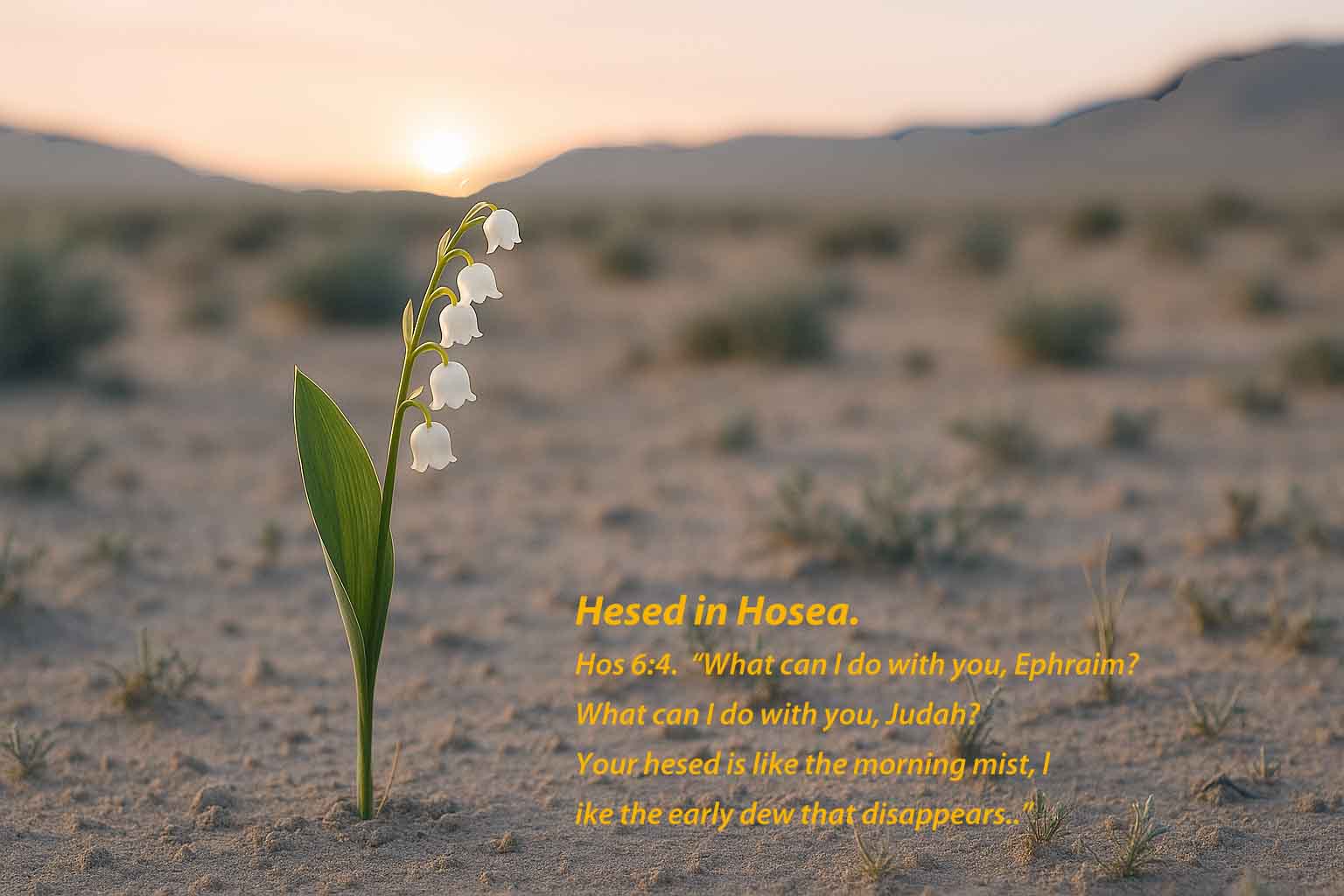
Study 3 Dew Like Hesed
Hosea 6:4 — “What
shall I do with you, O Ephraim? What shall I do with you, O Judah? Your ḥesed
is like a morning cloud, and like the early dew it goes away.”
1. A People Who Appear
Alive but Are Far From God
The setting of Hosea 6 is the same late period of the northern kingdom we have been tracing. The nation is outwardly prosperous, but below the surface it is in spiritual decay and approaching judgment. It still bears the outward form of being Yahweh’s people; sacrifices continued, festivals adorned the calendar, and the priests maintained their busy schedules.
Yet prosperity had become a veil over
apostasy. Israel assumed God’s favour because life still went smoothly. In that
complacency, Hosea delivered an oracle that stripped away the illusion of
covenant fidelity. God now confronts a people who believe they are returning to
Him, but whose repentance lacks substance.
The chapter opens with Israel’s confident cry: “Come, let us return to the Lord.” It sounds like revival; it reads like an awakening.
But the Lord’s response exposes the hollow centre: “Your ḥesed is like a morning cloud, and like the early dew it goes away.” Their covenant loyalty is a passing mood, not a persevering devotion. Israel’s words echo the language of repentance, but their hearts remain unchanged. Their appeal here is designed to keep the prosperity flowing, a tool in their kit bag for use when needed. It is not true repentance but a liturgy of entitlement. It warms quickly, cools quickly, and disappears almost before the sun rises.
Hosea meets us here with uncomfortable reality. It is possible for us to make resolutions and confessions, and yet remain unchanged. This happens when our resolve is an emotional impulse rather than the work of God’s renewing grace within us. The people of Hosea’s day were experts at religious enthusiasm. Like us, they could stir themselves into spiritual moments but could not sustain obedience in daily life. Sustained obedience is the work of the Holy Spirit who has taught us to see sin as an offence against a Holy God.
Such is the crisis into which Hosea now speaks 6:4. God exposes the difference between revivalism and repentance, between temporary resolve and enduring covenant love.
2. When Words of Return Mask Hearts That Will Not Yield
From the opening chapters of Hosea, the arc has been clear: the marriage that begun in love (Hos 1–2) fell into betrayal, and the covenant that once flourished now hangs by a thread. Gomer’s unfaithfulness has become the living emblem of Israel’s own betrayal of Yahweh.
The narrative flow of Hosea 6 is deceptively gentle. Israel believes that if they call upon the Lord, He will bind them, heal them, and revive them as though their restoration were automatic with the right words. The Lord had previously brought charges of adultery against the nation in 2:1ff. Then in 5:9–10, future judgment is declared “Ephraim shall be desolate…I will pour out My wrath on them like water”. Their words in verses 6:1–3 read like a shallow attempt to avert this judgment. They want restoration without righteousness, renewal without repentance. They want the benefits of the Lord’s covenant favour without the obligations of covenant fidelity.
The Lord’s reply shatters the pretence: “What shall I do with you?” These are the words of a husband grieved, the judge perplexed, not because His purposes are uncertain but because Israel’s heart is unfaithful. The rhetorical question reveals both severity and tenderness at once. God desires to heal, but the patient refuses His cure. God desires to restore, but the people offer a loyalty that evaporates in the heat of ordinary life.
Hosea’s narrative moves from Israel’s shallow confession to God’s diagnosis. The sun rises, the dew disappears, and what looked like repentance is shown to be short-lived zeal. The Valley-of-Achor pattern appears again but in reverse: where judgment once became hope (2:15), here, their enthusiasm becomes exposure. What Israel thought was spiritual return becomes the revelation of their covenant infidelity.
3. The Sin of Empty Words Before a Holy God
Hosea has already taught us that sin is not merely lawbreaking but covenant betrayal, an attempt to possess life without dependence upon God. In chapter 6, this autonomy takes a subtler form. Israel’s sin is not only disobedience but the presumption that the right words can pacify the Lord. Their ḥesed, as it were, flickers but never endures. They are quick to speak of returning, slow to persevere in obedience.
This lifestyle is moral and relational. It mirrors Adam’s condition in Hosea 6:7: “Like Adam they transgressed the covenant.” Adam’s first transgression was not simply an act of rebellion but a failure to remain steadfast. Adam reached for independence; Israel reaches for spiritual self-management. Their repentance is their own work, on their own terms, according to their own timetable.
The paradox here is theological and searching:
God desires steadfast love from a people incapable of producing it, yet He condemns them for lacking it.
The covenant demands what human nature cannot supply; yet the demand is just because the covenant relationship required it. Israel’s inability does not excuse their instability. The purpose of the demand is not to expose futility but to drive them to the God who’s own ḥesed endures forever.
4. Idolatry Exposed — When Worship Feels Deep but Lives Remain Unchanged
Baal worship in Hosea’s day offered immediate gratification. Rituals produced emotional intensity, sensual fulfilment, and seasonal optimism. It was religion engineered for effect. And Israel imported that instinct into Yahweh’s worship. They learned to feel deeply without obeying deeply. They bowed in liturgies they did not believe. Their worship created a spiritual high but not a holy life.
This idolatry remains among us. Many of us today are carried along by the same “morning-cloud” devotion. Our gatherings can generate momentary conviction without lasting transformation. We substitute sentiment for surrender, technique for truth, passion for perseverance. We may lift our hands on Sunday and forget His commandments (and our resolutions) by Monday. We may be moved by a stirring chorus yet avoid the costly obedience that true repentance demands.
Modern Baalism is not in shrines but in hearts hungry for spiritual experiences. Experiences that do not require the spiritual death of self, as Gal 2:20 reminds us. The Church often seeks renewal through mood rather than holiness. We have believed the lie that sincerity is enough and that God should honour our momentary earnestness. This Baal god is, as Os Guinness puts it: “A tame god, a user-friendly god who exists by human manufacture, is at human disposal, and is under human control.”[i] But Hosea teaches otherwise: the Lord sees through temporary affection. He asks not for enthusiasm but for endurance.
5. What the Lord Sees When Our Love Vanishes at Dawn
In Hosea 6:4, ḥesed names what Israel ought to possess but does not. It describes covenant loyalty expressed in faithfulness, mercy, steadfastness, and obedience. It acts as a description here of the love that remains when feeling cools, the devotion that acts when emotion fades.
The imagery of “morning cloud” and “early dew” does not primarily evoke sentimentality; it conveys impermanence. Dew appears in the night but vanishes when confronted by the rising sun. Hosea is using the terms here as visual aids to teach Israel how the Lord views their efforts. Such efforts are momentary, and vanish when the struggles of life come in upon us.
This verse compares human ḥesed with divine ḥesed by way of contrast:
– Human ḥesed: brief, fluctuating, evaporating.
– Divine ḥesed: eternal, covenantal, persevering.
The doctrine that emerges is weighty: true covenant love must be God-given if it is to be God-like. Israel cannot manufacture ḥesed. They must receive it. The failure of human loyalty reveals the necessity of divine renewal. In Hosea’s unfolding message, the cure for evaporating devotion is not stronger resolve but divine re-creation. The Lord must implant in His people the very loyalty He requires of them. Not only is confession of sin needed, but confession of their need for the Lord’s work upon their heart.
That is why verse 6:6 follows so naturally: “I desire ḥesed and not sacrifice.” God does not reject sacrifice in principle but rejects sacrifice that lacks covenant fidelity. Ritual without ḥesed is hypocrisy. Worship without endurance is rebellion dressed as reverence. Such worship has the self as its god and not the Lord.
6. How False Religion Forms False Repentance
Hosea 6 confronts the people’s counterfeit repentance, but this shallow return does not arise in a vacuum. Hosea has already exposed in chapters 4 and 5 the priests and prophets who misled the nation, healing the wound of the people lightly and reinforcing a religion without covenant fidelity. Their teaching prepared the soil in which Israel’s dew-like hesed grew. Thus, when Israel says, ‘Come, let us return to the Lord,’ their words echo the superficial religion their leaders have cultivated — a seeking of God shaped by presumption rather than repentance.
Hosea exposes the whole religious system as complicit. Instead of calling Israel to steadfast devotion, the priests enabled her unfaithfulness. They treated sin with sentiment and replaced holiness with ceremony. They encouraged a form of piety that lacked the substance of covenant love.
Our era is not far removed. Contemporary pulpits often offer a gospel of comfort without confrontation. We speak of healing without holiness, purpose without repentance, reassurance without obedience. Such preaching cultivates believers whose ḥesed is a morning cloud. It produces disciples who can feel strongly but obey weakly, who return to the Lord emotionally but not covenantally.
The Lord’s prophetic confrontation stands: “Your ḥesed is like the dew.” This is not the verdict of a harsh God but the grief of a holy Husband. He confronts us so that we may return, not by mood but by surrender.
7. The Call to Return With Covenant Loyalty To the God Who Gives Himself
Hosea’s word to Israel is also God’s word to us: examine the quality of your devotion. Is your repentance a mood that rises and falls with circumstances? Is your worship shaped by the moment or by the Master? Does your devotion endure beyond emotion into obedience, perseverance, and sacrifice? Is our devotion by faith or by sight? The latter will be like the morning dew.
The Lord does not despise weakness; He despises unfaithfulness. He does not reject trembling love; He rejects temporary love. True ḥesed is not perfect love but persevering love. It is the devotion that clings to God even when the heart feels cold, even when obedience feels costly, even when faithfulness seems impossible.
If our love is unstable, we must not despair. Rather, we return to the One whose ḥesed does not flicker or fade. The cure for evaporating devotion is to behold the steadfast love of the Lord. Hosea’s entire book teaches that God’s ḥesed heals our fickleness, His loyalty restores our wavering, His covenant mercy steadies our unstable hearts.
Therefore, we must turn to the Lord in the integrity He requires, not in the fleeting stirrings we have often mistaken for repentance. As Jesus said, “If anyone loves Me, he will keep My word.”, John 14:23. The call is not to emotion but to obedient love. Our ḥesed fails; His does not. The only path forward is to abandon the confidence we place in our own sincerity and to submit ourselves to the God whose steadfast love alone can establish ours.
Return to the Lord with the loyalty He commands. Lay aside the forms of devotion that vanish at dawn, and yield yourself to the One whose ḥesed endures when every other hope collapses.