State Funeral of John Laws
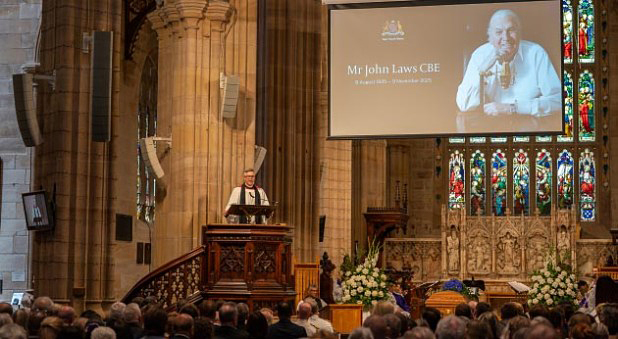
The State
Funeral of John Laws: Sermon by Michael Jensen 20 November, 2025.
The sermon for
John Laws’s state funeral deserves to be recognised with generous appreciation.
It was delivered in a charged national moment, before a largely secular
audience grieving for a man who shaped Australian culture for decades.
In that
environment the preacher, The Rev Dr Michael Jensen, achieved something
rare: a eulogy that honoured the deceased without mythologising him, and a
homily that gently introduced listeners to the person of Jesus Christ without
tripping cultural alarms or alienating mourners.
The central
metaphor, drawing a line between the Voice of God in John 1 and the iconic
radio voice of Golden Tonsils, was not a contrivance but a stroke of pastoral
imagination. It invited listeners to consider that the familiarity they felt
with Laws’s voice was a faint echo of a deeper, older Voice that speaks
creation into being. That voice speaks grace into human sorrow.
This weaving
together of national affection and divine revelation was dignified, human, and
quietly theological. Yet when we consider a biblical analogue for preaching
Christ in a culturally prestigious yet spiritually indifferent setting, the
Areopagus scene in Acts 17 becomes instructive. Paul stands before the
intellectual elite of Athens, acknowledging their culture, referencing their
poets, and respectfully engaging their worldview. But he also brings the
message to a decisive point, naming the risen Christ as judge and calling all
people everywhere to repent.
Paul’s tone is
not harsh. His argument is not tribal. His manner is not confrontational. The
call to repent appears not as a scolding command but as a natural relational
consequence of having met the true God who made the world, who gives life, and
who now draws near offering comfort through Jesus.
Jensen’s sermon
already contained the seeds for such a moment. He spoke of Jesus shouldering
guilt, carrying our regrets, and taking on our death. It portrayed him as the
one in whom kindness is pure rather than shadowed. It described God as inviting
the wounded and weary home. In fact, much of the emotional logic of the sermon
already aligns with the biblical dynamic of repentance understood as turning,
returning, or coming home.
The sermon, by
highlighting Laws’s honest recognition of his flaws, prepared the ground for a
wider confession that every Australian needs to recognise their flaws too.
Death is inevitable. Had the Areopagus pattern been allowed to flower in one
more carefully placed movement, the sermon could have gently risen from a
beautiful eulogy to a fuller proclamation.
A single
sentence could have provided this lift without disturbing the atmosphere of
honour, grief, and national unity. Something such as: The Voice from above
invites each of us to confess our perceived flaws to Him. To receive the comfort
and forgiveness we long for and cannot find elsewhere.
Such a line
would not have condemned the hearers; it would have dignified them with the
truth that the God who entered our world in Christ calls all people home. Its
tone would harmonise with the broader theme of kindness, which Laws himself
championed, and which the sermon rightly placed at the centre of Christian
grace.
Repentance, in
this Areopagus sense, is not a harsh interruption but the natural completion of
the gospel’s logic. The kindness of God becomes clearer when it is shown to
meet real human suffering. The invitation of Christ becomes more compelling
when it is understood as a call to return. Afterall, it is never a demand to
reform oneself anyway.
The
resurrection, which Paul used as the culminating proof of God’s appointed Judge
may have been a step too far in this funeral. I can’t comment on that. But had
the preacher consider it possible, it would have given the sermon a gentle
eschatological horizon: a reminder that the Voice from above is not silenced by
death.
With such additions
the sermon would remain exactly what it already was, a gracious tribute in the
public square, yet it would also become what every gospel message longs to be,
an invitation to hear the living Christ and turn toward him in hope. Having
said all of this, we can give thanks to God, that the The Rev Dr Michael Jensen
was bold to mention Jesus Christ when many of us would have shrunk from doing
so.
The text of the
sermon may be read here: Homily for John Laws.