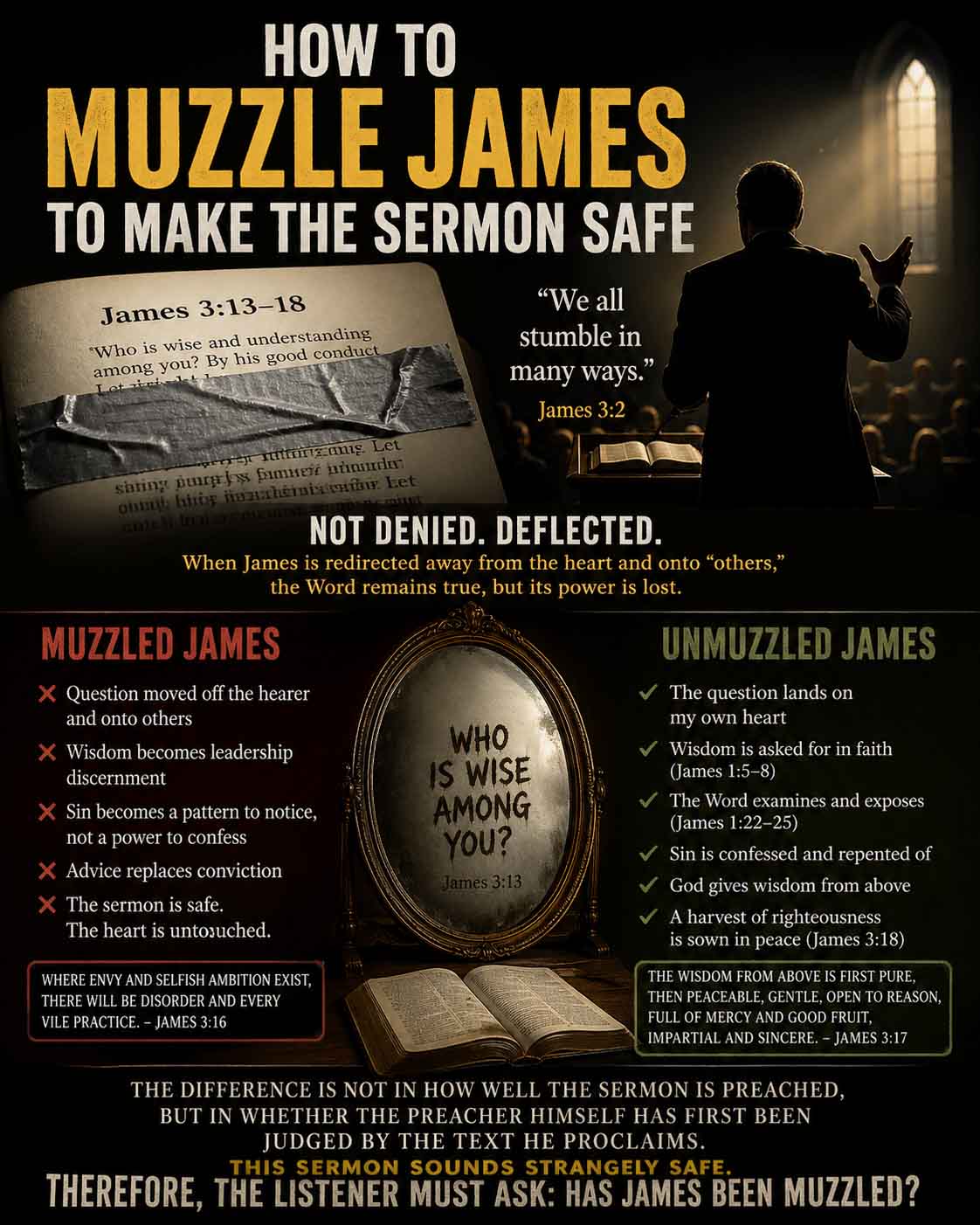
How to Muzzle James to Make the Sermon Safe: A Textbook Example.
A sermon can be
exegetically sound and spiritually evasive at the same time. A returning guest
preacher to Woori Yallock Presbyterian Church, Rev Andrew Matthews, did this in
his sermon on the passage James 3:13–18. This brief essay, in a series
focusing on sermon architecture, is simply to look at how a preacher can muzzle
God's Word without it being detected.
The sermon we are
looking at was competently preached by an experienced minister but the sermon shows
that the Word is not emptied of power only when it is denied, but when its
penetrating edge is redirected away from the one who hears it to “others”.
Referring first to the
passage we see that James does not open with advice as the sermon does. James
opens with a question that summons the conscience: “Who is wise?” The first
deviation in this sermon occurs when that question is moved off the hearer and
onto others. Instead of landing on the listener’s heart, it is turned into an
exercise in leadership discernment by office bearers within the church. The
hearer becomes an assessor of others, not the one to be assessed. In that
moment, the Word has been displaced.
Sure, the preacher’s
claim that ministers, by virtue of training and responsibility, must assess who
is wise when appointing leaders is not without warrant. Other parts of New
Testament clearly require the church to examine character for office. Yet that
is not the burden of Epistle of James 3:13–18. Here, James does not begin with
the church evaluating candidates, but with the individual heart being exposed.
The question “Who is wise?” is not directed to a church court determining
suitability, but to a congregation being summoned to self-examination.
When that distinction is blurred, the force of the passage is redirected. What James intends as a mirror becomes a tool. The hearer is moved from the position of being examined to that of examining others. The grammar reinforces our understanding here: the singular imperative (“let
him show”), the explicit location of envy and ambition “in your hearts,” and the diagnostic language throughout all press inward before they ever move outward. The church may indeed recognise wisdom in due course, but that recognition is the result, not the starting point.
To begin where James does not begin is to alter the function of the text. The passage is not first about selecting the wise, but about exposing the wisdom we already possess and contrasting it with Godly wuisdom. Only when that is faced can the church rightly discern anything at all.
A true reading of James though will not permit that move. In 1:5–8, wisdom is something to be asked for by a divided heart. In 1:22–25, the Word is a mirror that must be looked into, not a window through which others are viewed. A sermon that speaks of wisdom while leaving the hearer’s heart unexamined has already contradicted the letter’s opening logic. It has replaced need with observation.
Chapter 2 of James presses the matter into ordinary life. Partiality reveals what governs the heart in everyday decisions. Faith is not measured by claims but by works that expose whether it is living or dead. This is not a framework for evaluating others first. It is a summons to recognise that my faith is on trial in my actions. When the sermon settles into behavioural markers in others, it abandons that trial.
The warning to the preacher in 3:1–12 makes the avoidance even more serious. “We all stumble in many ways.” The tongue exposes the heart, especially in teaching. When 3:13–18 follows, the description of “bitter envy and selfish ambition” is not distant analysis. It is a present danger in the very act of preaching. To speak of it as though it belongs elsewhere is to ignore the context’s direct warning to the speaker.
James then names the source: “earthly, unspiritual, demonic.” This is not rhetorical excess and to be fair, Rev Matthews acknowledges this. It is a diagnosis. In 1:13–15, desire conceives and gives birth to sin. The root is within. However, when the sermon explains these categories but does not locate them in the hearer’s own desires, it severs cause from effect. Sin becomes a pattern to notice rather than a power to confess within one’s own heart.
The contrast in 3:17–18 is no less searching. The wisdom from above is pure, peaceable, gentle, open, merciful, sincere. But this is not a list of refinements. It is the fruit of a life reordered by God’s gift. Without the prior verdict on my present wisdom, these qualities become aspirations that leave the root intact. The sermon may commend them, but it has not produced them.
James himself provides the authoritative interpretation in 4:1: “What causes quarrels and fights among you? Is it not this, that your passions are at war within you?” The issue is internal; it is a heart issue. The call that follows is unmistakable: “God opposes the proud but gives grace to the humble… cleanse your hands… purify your hearts.” This is the movement of the letter:
TEXT → HEART → VERDICT → REPENTANCE → GOD → FRUIT. Any sermon on this passage that does not travel that path has not followed James.
This is where the sermon's failure becomes plain. When 3:13–18 is preached as:
TEXT → LEADERSHIP DISCERNMENT → BEHAVIOURAL MARKERS,
The letter has been re-engineered! What was given to expose and convert is used to categorise and advise. The Word remains true, but its force has been muzzled.
The sermon is treating the passage as though James was primarily saying:
→ “Church, identify wise people.”
But James is actually saying:
→ “Each of you, examine what is ruling you.”
→ “And the church will become what your hearts are producing.”
Yet this outward-looking reading is not driven by the text itself, but imposed upon it, for the grammar of Epistle of James 3:13–18 consistently directs its force inward to the heart, not outward to the assessment of others. We can best see this if we refer to the Greek text the minister would have been using in his sermon preparation.
The Greek of James 3:13–18 reinforces this inward movement I am referring to from the outset. James opens the passage with τίς σοφὸς καὶ ἐπιστήμων ἐν ὑμῖν; (“Who is wise and understanding among you?”). The phrase ἐν ὑμῖν clearly situates the question within the community, so there is a corporate setting to the discussion. Wisdom is not conceived as a private abstraction but something that exists within the life of the church. This allows for a visible, communal dimension. However, the interrogative τίς (who) does not assign the task of identifying others; it simply opens the category and requires that it be filled. The grammar does not direct the hearers outward to assess candidates, but sets up a claim that must be demonstrated rather than asserted. As both John Calvin and Douglas Moo observe in different ways, the question is designed to test pretensions to wisdom rather than to establish a process of recognition.
This is confirmed immediately by the imperative that follows: δειξάτω ἐκ τῆς καλῆς ἀναστροφῆς (“let him show by his good conduct”). The verb δειξάτω is aorist imperative, third person singular. This is crucial. James does not say, “let them be recognised,” nor does he employ a plural that would direct the community to identify individuals. Instead, the burden falls on the one who would claim wisdom: let him show. The emphasis is on demonstration, not designation. While the verb implies visibility—wisdom will inevitably be seen in a life—it does not establish a mechanism of external evaluation as the primary movement. As Thomas Manton notes, the text places the proof within the life of the individual, not within the judgment of the observers. Recognition may follow, but it is derivative, not foundational.
James further qualifies this demonstration with the phrase ἐν πραΰτητι σοφίας (“in the meekness of wisdom”). This prepositional phrase governs the manner in which wisdom is shown. Meekness (πραΰτης) is not an optional virtue added to wisdom, but the very mode in which wisdom expresses itself. This is significant grammatically and theologically. The demonstration of wisdom is itself characterised by humility, not self-assertion. As John Calvin insists, true wisdom cannot be separated from humility, so that any attempt to present oneself as wise in a self-promoting or competitive manner already contradicts the essence of the term.
So whilst the sermon skirts around these issues as it promotes the assessor angle, the grammar resists any reading that would turn wisdom into a status to be recognised or attained through visible distinction. It must be embodied in a way that undermines self-display.
The inward thrust of the passage becomes explicit and unavoidable in verse 14: εἰ δὲ ζῆλον πικρὸν ἔχετε καὶ ἐριθείαν ἐν τῇ καρδίᾳ ὑμῶν (“But if you have bitter envy and selfish ambition in your hearts”). The verb ἔχετε is present indicative active, indicating ongoing possession rather than occasional action. More importantly, the phrase ἐν τῇ καρδίᾳ ὑμῶν locates the problem internally. This is decisive for interpretation. James does not speak of envy and ambition merely as observable behaviours within the community, but as realities possessed within the heart. As Douglas Moo and Peter Davids both emphasise, the focus is on motive and source, not merely on external manifestation. The grammar explicitly grounds the problem in the inner life of the individual, even though its effects will inevitably be seen in the community.
This internalisation is reinforced by the prohibitions that follow: μὴ κατακαυχᾶσθε καὶ ψεύδεσθε κατὰ τῆς ἀληθείας (“do not boast and lie against the truth”). These verbs, functioning as ongoing prohibitions, assume that those addressed may still claim wisdom while harbouring these inward realities. The issue, therefore, is not ignorance but self-deception. The one who possesses such motives may continue to assert wisdom, but in doing so he “lies against the truth.” This is not neutral instruction but judicial exposure. The emphatic rejection that follows—οὐκ ἔστιν αὕτη ἡ σοφία (“this is not the wisdom”)—uses the demonstrative αὕτη to point directly at the supposed wisdom and deny its legitimacy. The predicates ἐπίγειος, ψυχική, δαιμονιώδης (“earthly, unspiritual, demonic”) do not merely describe its quality but reclassify its source. As Calvin observes, this is not a lesser form of wisdom but a fundamentally different one, arising not from God but from below.
By contrast, when James turns to the wisdom from above, he does so using the present indicative: ἡ δὲ ἄνωθεν σοφία… ἐστιν (“the wisdom from above is…”). This is not exhortational language but descriptive. As Douglas Moo notes, the list that follows—pure, peaceable, gentle, open, full of mercy and good fruits, impartial and sincere—does not function as a set of commands to be obeyed but as characteristics that identify the nature of true wisdom. These are not aspirational virtues in isolation, but evidences of origin. Without the prior exposure of false wisdom, they can easily be reduced to ethical ideals. Grammatically, however, they serve to distinguish one kind of wisdom from another at the level of source.
Finally, the closing clause, καρπὸς δικαιοσύνης ἐν εἰρήνῃ σπείρεται (“a harvest of righteousness is sown in peace”), brings the corporate implications into view. The outcomes described are communal: disorder and every vile practice on the one hand, righteousness and peace on the other. Yet these outcomes are not presented as starting points for evaluation but as the inevitable results of what governs the heart. The grammar therefore establishes a clear movement: inward source, outward consequence. The community experiences the fruit, but the individual heart determines the harvest.
Taken together, these grammatical features support a consistent interpretive direction. The passage does acknowledge a corporate setting and visible outcomes, and so the church will inevitably recognise wisdom in others. However, this is not where James begins. The grammar consistently presses inward, locating both false and true wisdom in the heart of his readers, and only then moving outward into communal effect. To reverse that order is not to contradict the text explicitly, but to displace its force, redirecting what is meant to be a text requiring searching self-examination into an exercise in observing others.
Even the strongest material within the sermon cannot recover that loss if the structure is wrong. Near the end of the sermon, there was a careful and pastorally helpful treatment of being “open to reason.” That is exactly the texture James intends. Yet it was presented as relational wisdom to adopt, rather than the fruit of a heart that has been brought low. Without the prior exposure of envy and ambition, “be reasonable” becomes a technique to adopt. It may improve tone, but it leaves one’s self-will in place.
John Calvin is helpful here. He will not permit such a reading. For him, the question “Who is wise?” is a summons to self-examination. Envy and ambition are not traits to identify in others but evidence that one’s own claim to wisdom collapses. The language “earthly, unspiritual, demonic” is not filed away as doctrine; it is felt as judgment. Only then does he turn to God as the giver of true wisdom. The fruit that follows is not cultivated behaviour but granted transformation.
We need to uncover a deeper issue running beneath all of this. James 3:1 has already warned that teachers will be judged more strictly, and that “we all stumble in many ways.” The preacher is not exempt from the searching power of the Word; he is its first subject. If the text has not first examined him—if his envy, ambition, and self-advancing wisdom have not been exposed in the privacy of his study and repented of in his own heart—then he will, almost instinctively, redirect that examination away from himself and his hearers. The deflection we have traced in the sermon is not accidental. It is the natural outcome of a preacher who has not yet stood fully under the verdict of the text he proclaims.
The issue, then, is not whether the sermon says true things. It is whether it allows the text to do what it was given to do. When the heart is not searched, repentance does not occur. When repentance does not occur, Christ is reduced to a supplier of better qualities rather than the Lord who judges and replaces false wisdom. And when that happens, the church may speak often of wisdom while quietly operating on envy and ambition.
James leaves no room for neutrality. “The wisdom from above is first pure.” If what governs me is not that, then it is not from above. There is no middle ground. We are not naturally inclined to this wisdom. We are born with, and quickly learn to refine, the very wisdom James condemns—earthly, unspiritual, demonic. It is the instinct of the fallen heart: to advance self, to envy others, to secure position, even under the guise of service.
Either the Word is allowed to search every heart, exposing its envy and ambition, and drive the hearer to humble repentance before God, or it must be redirected, softened, and rendered safe. And where that happens, the outcome is not merely a weaker sermon, but a compromised church. For where envy and selfish ambition remain unjudged, disorder will follow. But where the Word is allowed to do its work—where that native wisdom is confessed, renounced, and replaced—there will be a harvest of righteousness sown in peace.
The difference then, is not in how well the sermon is preached, but in whether the preacher himself has first been judged by the text he proclaims. This sermon sounds strangely safe. When James asks "Who is wise among you", the hearer of God's Word asks the Word to search their own heart by asking "Am I wise"? Is earthly wisdom and it's demonic influences lurking unexposed in my heart? Therefore, in response to this sermon, the listener must ask "has James been muzzled"?
The sermon may be viewed at
him show”), the explicit location of envy and ambition “in your hearts,” and the diagnostic language throughout all press inward before they ever move outward. The church may indeed recognise wisdom in due course, but that recognition is the result, not the starting point.
To begin where James does not begin is to alter the function of the text. The passage is not first about selecting the wise, but about exposing the wisdom we already possess and contrasting it with Godly wuisdom. Only when that is faced can the church rightly discern anything at all.
A true reading of James though will not permit that move. In 1:5–8, wisdom is something to be asked for by a divided heart. In 1:22–25, the Word is a mirror that must be looked into, not a window through which others are viewed. A sermon that speaks of wisdom while leaving the hearer’s heart unexamined has already contradicted the letter’s opening logic. It has replaced need with observation.
Chapter 2 of James presses the matter into ordinary life. Partiality reveals what governs the heart in everyday decisions. Faith is not measured by claims but by works that expose whether it is living or dead. This is not a framework for evaluating others first. It is a summons to recognise that my faith is on trial in my actions. When the sermon settles into behavioural markers in others, it abandons that trial.
The warning to the preacher in 3:1–12 makes the avoidance even more serious. “We all stumble in many ways.” The tongue exposes the heart, especially in teaching. When 3:13–18 follows, the description of “bitter envy and selfish ambition” is not distant analysis. It is a present danger in the very act of preaching. To speak of it as though it belongs elsewhere is to ignore the context’s direct warning to the speaker.
James then names the source: “earthly, unspiritual, demonic.” This is not rhetorical excess and to be fair, Rev Matthews acknowledges this. It is a diagnosis. In 1:13–15, desire conceives and gives birth to sin. The root is within. However, when the sermon explains these categories but does not locate them in the hearer’s own desires, it severs cause from effect. Sin becomes a pattern to notice rather than a power to confess within one’s own heart.
The contrast in 3:17–18 is no less searching. The wisdom from above is pure, peaceable, gentle, open, merciful, sincere. But this is not a list of refinements. It is the fruit of a life reordered by God’s gift. Without the prior verdict on my present wisdom, these qualities become aspirations that leave the root intact. The sermon may commend them, but it has not produced them.
James himself provides the authoritative interpretation in 4:1: “What causes quarrels and fights among you? Is it not this, that your passions are at war within you?” The issue is internal; it is a heart issue. The call that follows is unmistakable: “God opposes the proud but gives grace to the humble… cleanse your hands… purify your hearts.” This is the movement of the letter:
TEXT → HEART → VERDICT → REPENTANCE → GOD → FRUIT. Any sermon on this passage that does not travel that path has not followed James.
This is where the sermon's failure becomes plain. When 3:13–18 is preached as:
TEXT → LEADERSHIP DISCERNMENT → BEHAVIOURAL MARKERS,
The letter has been re-engineered! What was given to expose and convert is used to categorise and advise. The Word remains true, but its force has been muzzled.
The sermon is treating the passage as though James was primarily saying:
→ “Church, identify wise people.”
But James is actually saying:
→ “Each of you, examine what is ruling you.”
→ “And the church will become what your hearts are producing.”
Yet this outward-looking reading is not driven by the text itself, but imposed upon it, for the grammar of Epistle of James 3:13–18 consistently directs its force inward to the heart, not outward to the assessment of others. We can best see this if we refer to the Greek text the minister would have been using in his sermon preparation.
The Greek of James 3:13–18 reinforces this inward movement I am referring to from the outset. James opens the passage with τίς σοφὸς καὶ ἐπιστήμων ἐν ὑμῖν; (“Who is wise and understanding among you?”). The phrase ἐν ὑμῖν clearly situates the question within the community, so there is a corporate setting to the discussion. Wisdom is not conceived as a private abstraction but something that exists within the life of the church. This allows for a visible, communal dimension. However, the interrogative τίς (who) does not assign the task of identifying others; it simply opens the category and requires that it be filled. The grammar does not direct the hearers outward to assess candidates, but sets up a claim that must be demonstrated rather than asserted. As both John Calvin and Douglas Moo observe in different ways, the question is designed to test pretensions to wisdom rather than to establish a process of recognition.
This is confirmed immediately by the imperative that follows: δειξάτω ἐκ τῆς καλῆς ἀναστροφῆς (“let him show by his good conduct”). The verb δειξάτω is aorist imperative, third person singular. This is crucial. James does not say, “let them be recognised,” nor does he employ a plural that would direct the community to identify individuals. Instead, the burden falls on the one who would claim wisdom: let him show. The emphasis is on demonstration, not designation. While the verb implies visibility—wisdom will inevitably be seen in a life—it does not establish a mechanism of external evaluation as the primary movement. As Thomas Manton notes, the text places the proof within the life of the individual, not within the judgment of the observers. Recognition may follow, but it is derivative, not foundational.
James further qualifies this demonstration with the phrase ἐν πραΰτητι σοφίας (“in the meekness of wisdom”). This prepositional phrase governs the manner in which wisdom is shown. Meekness (πραΰτης) is not an optional virtue added to wisdom, but the very mode in which wisdom expresses itself. This is significant grammatically and theologically. The demonstration of wisdom is itself characterised by humility, not self-assertion. As John Calvin insists, true wisdom cannot be separated from humility, so that any attempt to present oneself as wise in a self-promoting or competitive manner already contradicts the essence of the term.
So whilst the sermon skirts around these issues as it promotes the assessor angle, the grammar resists any reading that would turn wisdom into a status to be recognised or attained through visible distinction. It must be embodied in a way that undermines self-display.
The inward thrust of the passage becomes explicit and unavoidable in verse 14: εἰ δὲ ζῆλον πικρὸν ἔχετε καὶ ἐριθείαν ἐν τῇ καρδίᾳ ὑμῶν (“But if you have bitter envy and selfish ambition in your hearts”). The verb ἔχετε is present indicative active, indicating ongoing possession rather than occasional action. More importantly, the phrase ἐν τῇ καρδίᾳ ὑμῶν locates the problem internally. This is decisive for interpretation. James does not speak of envy and ambition merely as observable behaviours within the community, but as realities possessed within the heart. As Douglas Moo and Peter Davids both emphasise, the focus is on motive and source, not merely on external manifestation. The grammar explicitly grounds the problem in the inner life of the individual, even though its effects will inevitably be seen in the community.
This internalisation is reinforced by the prohibitions that follow: μὴ κατακαυχᾶσθε καὶ ψεύδεσθε κατὰ τῆς ἀληθείας (“do not boast and lie against the truth”). These verbs, functioning as ongoing prohibitions, assume that those addressed may still claim wisdom while harbouring these inward realities. The issue, therefore, is not ignorance but self-deception. The one who possesses such motives may continue to assert wisdom, but in doing so he “lies against the truth.” This is not neutral instruction but judicial exposure. The emphatic rejection that follows—οὐκ ἔστιν αὕτη ἡ σοφία (“this is not the wisdom”)—uses the demonstrative αὕτη to point directly at the supposed wisdom and deny its legitimacy. The predicates ἐπίγειος, ψυχική, δαιμονιώδης (“earthly, unspiritual, demonic”) do not merely describe its quality but reclassify its source. As Calvin observes, this is not a lesser form of wisdom but a fundamentally different one, arising not from God but from below.
By contrast, when James turns to the wisdom from above, he does so using the present indicative: ἡ δὲ ἄνωθεν σοφία… ἐστιν (“the wisdom from above is…”). This is not exhortational language but descriptive. As Douglas Moo notes, the list that follows—pure, peaceable, gentle, open, full of mercy and good fruits, impartial and sincere—does not function as a set of commands to be obeyed but as characteristics that identify the nature of true wisdom. These are not aspirational virtues in isolation, but evidences of origin. Without the prior exposure of false wisdom, they can easily be reduced to ethical ideals. Grammatically, however, they serve to distinguish one kind of wisdom from another at the level of source.
Finally, the closing clause, καρπὸς δικαιοσύνης ἐν εἰρήνῃ σπείρεται (“a harvest of righteousness is sown in peace”), brings the corporate implications into view. The outcomes described are communal: disorder and every vile practice on the one hand, righteousness and peace on the other. Yet these outcomes are not presented as starting points for evaluation but as the inevitable results of what governs the heart. The grammar therefore establishes a clear movement: inward source, outward consequence. The community experiences the fruit, but the individual heart determines the harvest.
Taken together, these grammatical features support a consistent interpretive direction. The passage does acknowledge a corporate setting and visible outcomes, and so the church will inevitably recognise wisdom in others. However, this is not where James begins. The grammar consistently presses inward, locating both false and true wisdom in the heart of his readers, and only then moving outward into communal effect. To reverse that order is not to contradict the text explicitly, but to displace its force, redirecting what is meant to be a text requiring searching self-examination into an exercise in observing others.
Even the strongest material within the sermon cannot recover that loss if the structure is wrong. Near the end of the sermon, there was a careful and pastorally helpful treatment of being “open to reason.” That is exactly the texture James intends. Yet it was presented as relational wisdom to adopt, rather than the fruit of a heart that has been brought low. Without the prior exposure of envy and ambition, “be reasonable” becomes a technique to adopt. It may improve tone, but it leaves one’s self-will in place.
John Calvin is helpful here. He will not permit such a reading. For him, the question “Who is wise?” is a summons to self-examination. Envy and ambition are not traits to identify in others but evidence that one’s own claim to wisdom collapses. The language “earthly, unspiritual, demonic” is not filed away as doctrine; it is felt as judgment. Only then does he turn to God as the giver of true wisdom. The fruit that follows is not cultivated behaviour but granted transformation.
We need to uncover a deeper issue running beneath all of this. James 3:1 has already warned that teachers will be judged more strictly, and that “we all stumble in many ways.” The preacher is not exempt from the searching power of the Word; he is its first subject. If the text has not first examined him—if his envy, ambition, and self-advancing wisdom have not been exposed in the privacy of his study and repented of in his own heart—then he will, almost instinctively, redirect that examination away from himself and his hearers. The deflection we have traced in the sermon is not accidental. It is the natural outcome of a preacher who has not yet stood fully under the verdict of the text he proclaims.
The issue, then, is not whether the sermon says true things. It is whether it allows the text to do what it was given to do. When the heart is not searched, repentance does not occur. When repentance does not occur, Christ is reduced to a supplier of better qualities rather than the Lord who judges and replaces false wisdom. And when that happens, the church may speak often of wisdom while quietly operating on envy and ambition.
James leaves no room for neutrality. “The wisdom from above is first pure.” If what governs me is not that, then it is not from above. There is no middle ground. We are not naturally inclined to this wisdom. We are born with, and quickly learn to refine, the very wisdom James condemns—earthly, unspiritual, demonic. It is the instinct of the fallen heart: to advance self, to envy others, to secure position, even under the guise of service.
Either the Word is allowed to search every heart, exposing its envy and ambition, and drive the hearer to humble repentance before God, or it must be redirected, softened, and rendered safe. And where that happens, the outcome is not merely a weaker sermon, but a compromised church. For where envy and selfish ambition remain unjudged, disorder will follow. But where the Word is allowed to do its work—where that native wisdom is confessed, renounced, and replaced—there will be a harvest of righteousness sown in peace.
The difference then, is not in how well the sermon is preached, but in whether the preacher himself has first been judged by the text he proclaims. This sermon sounds strangely safe. When James asks "Who is wise among you", the hearer of God's Word asks the Word to search their own heart by asking "Am I wise"? Is earthly wisdom and it's demonic influences lurking unexposed in my heart? Therefore, in response to this sermon, the listener must ask "has James been muzzled"?
The sermon may be viewed at