One Topic, Two Sermons, Five Crucial Differences in How Sin Is Handled
The following brief essay
has only one purpose: to show how the modern therapeutic view of sin as a form
of brokenness stacks up against a covenantal view of sin. Rev Tony Archer is a contemporary
Presbyterian minister, whilst Rev Alexander MacLaren (1826 – 1910) was a
Scottish Baptist minister. Texts for both sermons are provided as PDFs. Archer’s
text was prepared from a YouTube video titled “Out of the Depths”, whilst
MacLaren’s sermon was prepared from a scan of a printed sermon titled “The
Weight of Sand”, published in 1896. Both texts have been minimally formatted but
both have artefacts that need to be overlooked. MacLaren’s sermon will be
referred to as Sermon A, and Archer’s sermon as Sermon B.
Both sermons speak about sin and were preached in their respective churches. That much is true. Both quote Scripture, both mention forgiveness, and both speak about Jesus. But sermons are not finally judged by the words they use. They are judged by how they define sin, and by what they teach people to do with their sin.
Here are five clear differences between the two sermons that help us understand what kind of preaching truly forms a Reformed, gospel-grounded congregation.
1. Sin as a real problem before God, or as a felt problem inside me
In Sermon A, sin is treated as a real problem before God, whether we feel it or not. Sin exists because God is holy and we are not. It does not wait for us to notice it. It does not depend on our emotional state. A person can feel calm, respectable, and untroubled, and still stand guilty before God.
In Sermon B, sin is treated mainly as a felt problem inside the person. Sin becomes serious when it overwhelms us, disturbs us, or causes anxiety. The focus is on inner distress: feeling far from God, worried that prayers are not heard, or afraid that nothing will change.
This matters because it trains us where to look. Sermon A teaches us to look upward, toward God’s judgment. Sermon B teaches us to look inward, toward our experience.
2. Sin as something that quietly accumulates, or something that appears in crises
Sermon A teaches that sin builds up over time. Small choices, small habits, small neglects of God quietly pile up like grains of sand. This means sin is most dangerous when it seems ordinary. The sermon warns us not to trust our sense of “I’m doing fine,” because sin works slowly and steadily. Original sin is not a concern for this sermon.
Sermon B, likewise is not concerned with original sin, but treats sin mostly as something that shows itself in moments of struggle. Sin appears when life is hard, when doubts rise, when conscience accuses, or when Satan whispers condemnation. The picture is of repeated spiritual battles rather than long-term moral accumulation.
One sermon warns us about the danger of quiet respectability. The other mainly addresses people who already feel distressed.
3. Sin as crushing guilt, or sin as spiritual instability
In Sermon A, sin is crushing because it is guilt before God. The weight of sin is legal and moral. One day, every life must be accounted for. Even many small sins, when added together, become unbearable. The hearer is meant to say, “I cannot stand under this.”
In Sermon B, sin is troubling because it creates instability. The fear is not so much judgment, but uncertainty: “Is God listening?” “Am I too far gone?” “Why hasn’t anything changed yet?” Sin shakes confidence and peace.
Both concerns are real, but only one goes to the root. Reformed preaching insists that the deepest problem is not anxiety but condemnation, and that peace cannot be stable until that problem is dealt with.
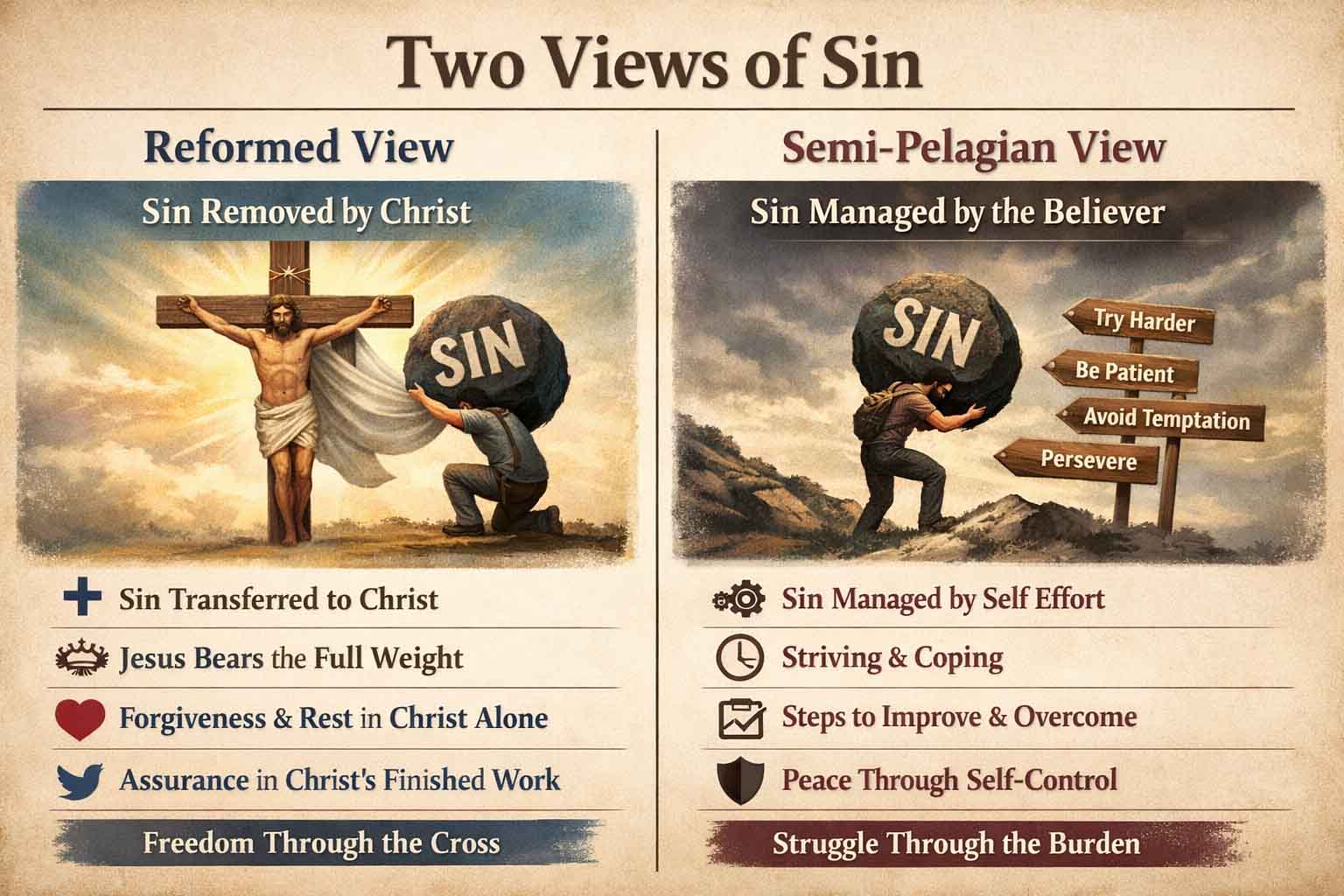
4. Sin removed by Christ, or sin managed by the believer
This difference goes to the heart of the gospel itself.
In Sermon A, sin is dealt with through substitution and transfer. Sin is not treated as a condition that gradually improves, nor as a burden that must be managed over time. It is treated as a weight that must be borne. The sermon insists that this burden cannot be shared, reduced, or disciplined away. It must either remain on the sinner or be laid upon another.
The gospel resolution, therefore, is not a change in the sinner’s posture but a change in the sinner’s standing. Christ bears the accumulated weight of sin fully and finally. Nothing remains to be carried by the believer. The hearer is not instructed to wait more faithfully, respond more carefully, or cultivate better spiritual habits in order to maintain peace. Rather, the hearer is summoned to relinquish all self-carrying and to rest in what Christ has already completed.
This handling of sin reflects classic Reformed theology: guilt is objective, substitution is decisive, and assurance rests on Christ’s finished work, not on the believer’s ongoing performance.
In Sermon B, sin is genuinely forgiven, but the practical handling of sin shifts after forgiveness has been announced. The believer is then guided into a pattern of spiritual regulation: waiting patiently, hoping rightly, guarding against false remedies, and persevering through uncertainty. These exhortations may be pastoral in intent and perhaps have some wisdom in isolation, but taken together they subtly reframe the believer’s relationship to sin.
Sin is no longer something decisively removed; it becomes something that continues to shape the believer’s spiritual equilibrium. Peace is portrayed as something that may come later, if the believer waits well. Assurance becomes vulnerable to the quality of the believer’s response. In practice, spiritual safety begins to rest not only on Christ’s work, but on the believer’s ability to maintain proper spiritual posture after forgiveness.
The unintended effect of this approach is that forgiveness, while affirmed, does not function as final. The believer is left managing the aftermath of sin rather than living from a settled deliverance. Over time, this can train consciences to look inward for stability rather than outward to Christ.
The distinction, then, is not between grace and works in name, but between grace that conclusively removes sin and grace that enables the believer to cope with sin. Reformed preaching insists on the former, precisely so that obedience, patience, and perseverance may flow from assurance rather than replace it.
5. What kind of Christians each sermon forms
Finally, we must ask what kind of people each sermon shapes.
Sermon A forms Christians who say:
“My sin is worse than I thought, but Christ is greater than I hoped. I am free.”
Sermon B risks forming Christians who say:
“I am forgiven, but I must be careful, watch myself closely, and make sure I’m responding the right way.”
One creates rested believers, anchored in what Christ has finished.
The other creates watchful believers, always checking their spiritual posture.
A simple test for discernment.
Here is a question every congregation should learn to ask:
When the sermon ended, where was the weight left?
- If the weight fell fully on Christ, that is Reformed preaching.
- If the weight quietly returned to the listener, even in gentle ways, something vital has been lost.
Good sermons seek to comfort.
Faithful sermons set captives free.
Learning to hear that difference will protect a congregation for years to come.
Sermon A: "The Weight of Sand" by Alexander MacLaren The-Weight-of-Sand.pdf
Sermon B: "Out of the Depths" by Tony Archer Psalm-130-by-Tony-Archer.pdf